淀粉样物质Amyloid · 胸腺 · 免疫系统 · NTP ntp-0020
诊断要点:胸腺中只要出现淀粉样物质,即应作出诊断并进行分级。由于淀粉样变性是一种全身性疾病,还应评估其他组织(如肝脏和肾脏)是否存在淀粉样物质沉积。
病变描述
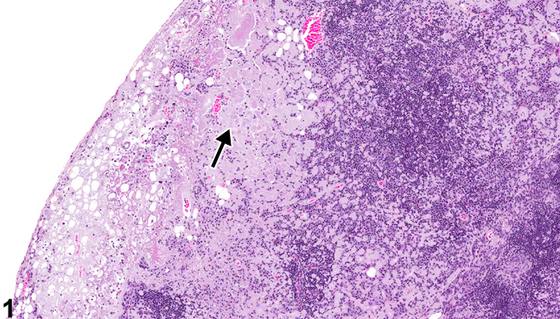
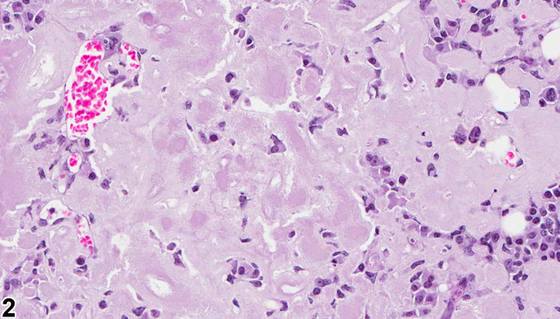
在啮齿类动物中,胸腺的自发性及化学诱导性淀粉样物质沉积罕见。当胸腺出现淀粉样物质时,在苏木精-伊红(H&E)染色下表现为无定形、嗜酸性、玻璃样变的细胞外物质(Figure 1、Figure 2,箭头)。刚果红染色后于偏振光下观察,淀粉样物质可呈现苹果绿双折射现象,据此可予以鉴定。
诊断与分级建议(NTP 共识)
胸腺中只要出现淀粉样物质,即应作出诊断并进行分级。由于淀粉样变性是一种全身性疾病,还应评估其他组织(如肝脏和肾脏)是否存在淀粉样物质沉积。继发性病变,如实质细胞坏死或变性,除非因严重程度需要或对研究结果的解释具有重要意义,否则不应单独诊断,但应在病理学叙述中予以描述。
图谱
英文原文
展开 NTP 官方英文描述与建议
Comment:
Spontaneous and chemically induced amyloid deposition in the thymus is rare in rodents. When present in the thymus, amyloid appears as amorphous, eosinophilic, and hyalinized extracellular material with hematoxylin and eosin (H&E) staining ( Figure 1 and Figure 2 , arrows). Amyloid can be identified by apple-green birefringence when stained with Congo red and visualized under polarized light.
Recommendation:
Whenever present in the thymus, amyloid should be diagnosed and graded. Because amyloidosis is a systemic disease, other tissues, such as liver and kidney, should also be evaluated for amyloid deposition. Secondary lesions, such as necrosis or degeneration of parenchymal cells, should not be diagnosed separately unless warranted by severity or important for interpretation of study results, but should be described in the pathology narrative.
来源与引用
原始条目:https://ntp.niehs.nih.gov/atlas/nnl/immune-system/thymus/Amyloid
图谱总目录:NTP Nonneoplastic Lesion Atlas。 内容属美国联邦政府作品(公有领域),可引用;引用时请标注来源。
建议引用格式:NTP Nonneoplastic Lesion Atlas. Amyloid (thymus). LabSmart 中文版:
https://www.labsmart.cn/ntp/thymus-amyloid.html
中文图谱总页(可展开对照全部 595 条):https://www.labsmart.cn/ntp-atlas.html#thymus-amyloid