炎症Inflammation · 骨髓 · 造血系统 · NTP ntp-0429
诊断要点:炎症应始终予以记录。严重程度分级应作为诊断的一部分,如有必要,应在病理描述中描述分布模式。
病变描述
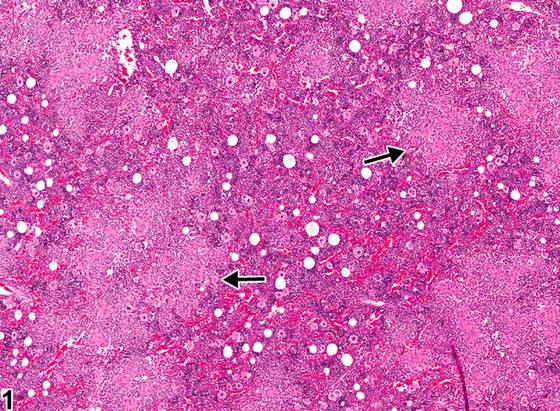
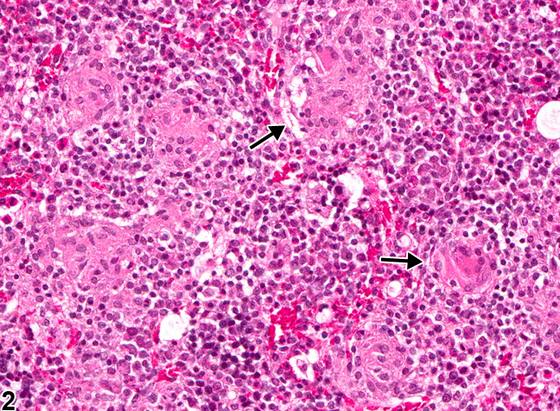
肉芽肿性炎症(肉芽肿性(granulomatous) inflammation)有时可见于啮齿类动物的骨髓。此类炎症主要由空泡化或上皮样巨噬细胞(epithelioid macrophage)构成,这些细胞呈相对界限清楚至有结构的聚集灶(Figure 1、Figure 2)或形成界限分明的致密肉芽肿(Figure 3、Figure 4)。上皮样巨噬细胞具有大量嗜酸性胞质及卵圆形至长形细胞核,染色质呈分散分布,其中数个细胞可融合形成多核巨细胞。与肉芽肿性炎症相关的其他细胞类型包括淋巴细胞、浆细胞、中性粒细胞和成纤维细胞,但这些并非恒定出现的特征。细胞内可见色素(含铁血黄素)或胆固醇裂隙。偶见肉芽肿性炎症伴有脂质空泡,这些空泡通常小于骨髓脂肪细胞的空泡,可见于巨噬细胞内及细胞外。这些病变似乎类似于已在人和犬骨髓中描述的所谓脂质性肉芽肿。肉芽肿性炎症可能与受试物给药或感染因子有关,但有时为非特异性所见。化脓性炎症(化脓性(suppurative) inflammation),如细菌性脓毒症时所发生者,在毒理学研究涉及的啮齿类动物骨髓中罕见观察到。其由非退变和退变的中性粒细胞聚集构成(Figure 5、Figure 6)。聚集灶内还可见来自驻留造血细胞和浸润白细胞的细胞碎片,以及蛋白性液体、纤维蛋白和少量淋巴细胞、浆细胞及巨噬细胞。其他所见可包括窦状隙扩张、间质水肿和/或出血。在NTP研究中,另有三种标准炎症类别:急性(急性(acute))、慢性(慢性(chronic))和慢性活动性(慢性活动性(chronic-active))。简言之,急性炎症中主要浸润细胞为中性粒细胞,但也可能有少量巨噬细胞和淋巴细胞。慢性炎症中以淋巴细胞为主;慢性活动性炎症中同样以淋巴细胞为主,但还存在相当数量的中性粒细胞——两种病变均可能含有巨噬细胞。这三种其他类别的炎症在骨髓中不常见或难以辨识,因为中性粒细胞属于驻留细胞群,而淋巴细胞不易识别——其形态与红系前体细胞极为相似。
诊断与分级建议(NTP 共识)
炎症应始终予以记录。严重程度分级应作为诊断的一部分,如有必要,应在病理描述中描述分布模式。相关病变,如血管扩张(angiectasis)或坏死,如严重程度需要,可单独诊断。不应使用“增生(hyperplasia)”、“浸润(infiltration)”或“细胞增多(hypercellularity)”这些术语来诊断这些特定病变。相关链接:骨髓 - 细胞浸润,组织细胞;骨髓 - 坏死
图谱
英文原文
展开 NTP 官方英文描述与建议
Comment:
Granulomatous inflammation is sometimes observed in the bone marrow of rodents. This type of inflammation consists predominately of vacuolated or epithelioid macrophages that occur in relatively well-defined to organized aggregates ( Figure 1 and Figure 2 ) or distinct compact granulomas ( Figure 3 and Figure 4 ). Epithelioid macrophages have large amounts of eosinophilic cytoplasm and an oval to elongated nucleus with a dispersed chromatin pattern, several of which may fuse to form a multinucleated giant cell. Other cell types associated with granulomatous inflammation are lymphocytes, plasma cells, neutrophils, and fibroblasts, but they are not all constant features. Intracellularly, pigment (hemosiderin) or cholesterol clefts may be seen. Occasionally, granulomatous inflammation is associated with lipid vacuoles that are usually smaller than the vacuoles of marrow adipocytes and are seen within macrophages and extracellularly. These lesions appear to be similar to the so-called lipid granulomas that have been described in human and canine bone marrow. Granulomatous inflammation may be associated with compound administration or infectious agents but is sometimes a nonspecific finding. Suppurative inflammation , as occurs with bacterial sepsis, is rarely observed in the bone marrow of rodents involved in toxicologic studies. It consists of aggregates of nondegenerate and degenerate neutrophils ( Figure 5 and Figure 6 ). Cell debris from the resident hematopoietic cells and the infiltrating leukocytes, as well as proteinaceous fluid, fibrin, and fewer lymphocytes, plasma cells, and macrophages, may also be present within the aggregates. Additional findings may include dilated sinusoids, interstitial edema, and/or hemorrhage. In NTP studies, there are three other standard categories of inflammation: acute, chronic, and chronic-active. Briefly, in acute inflammation , the predominant infiltrating cell is the neutrophil, though fewer macrophages and lymphocytes may also be present. Lymphocytes predominate in chronic inflammation ; lymphocytes also predominate in chronic-active inflammation , but there are also a significant number of neutrophils—both lesions may contain macrophages. These three other categories of inflammation are uncommon or are difficult to appreciate in the bone marrow because neutrophils are a resident population and lymphocytes are not easily identified—appearing very similar to erythroid precursors.
Recommendation:
Inflammation should always be recorded. Severity grading should be part of the diagnosis, and if warranted, the distribution pattern should be described in the pathology narrative. Associated lesions, such as angiectasis or necrosis, may be diagnosed separately if warranted by the severity. The terms "hyperplasia," "infiltration," or "hypercellularity" should not be used to diagnose these particular lesions. Related Links: Bone Marrow - Infiltration Cellular, Histiocyte Bone Marrow - Necrosis
来源与引用
原始条目:https://ntp.niehs.nih.gov/atlas/nnl/hematopoietic-system/bone-marrow/Inflammation
图谱总目录:NTP Nonneoplastic Lesion Atlas。 内容属美国联邦政府作品(公有领域),可引用;引用时请标注来源。
建议引用格式:NTP Nonneoplastic Lesion Atlas. Inflammation (bone-marrow). LabSmart 中文版:
https://www.labsmart.cn/ntp/bone-marrow-inflammation.html
中文图谱总页(可展开对照全部 595 条):https://www.labsmart.cn/ntp-atlas.html#bone-marrow-inflammation