囊肿Cyst · 卵巢 · 雌性生殖系统 · NTP ntp-0510
诊断要点:卵巢 - 囊肿应作出诊断,但不赋予严重程度分级。只要可能,囊肿类型(卵泡性、黄体性、上皮性、卵巢网、囊状、卵巢旁)应作为修饰词纳入诊断。
病变描述
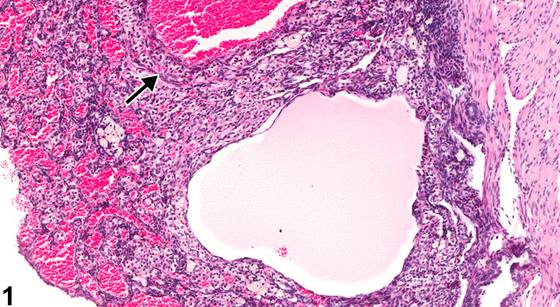
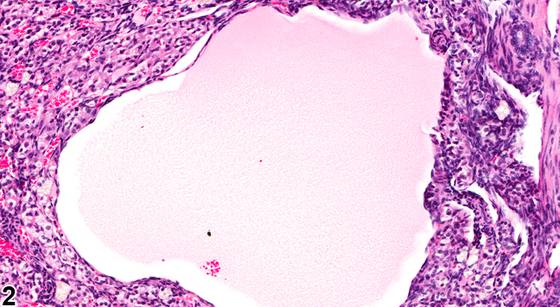
卵巢囊肿(ovarian cyst)是大鼠和小鼠中的常见所见(Figure 1、Figure 2、Figure 3、Figure 4)。卵巢囊肿可为单侧或双侧、单个或多个,并可变得相当大。理想情况下,囊肿应按起源、部位和/或形态学外观(卵泡性、黄体性、上皮性、卵巢网、囊状、卵巢旁)进行分类,这可提供关于毒性或致癌性研究中发病机制的信息。然而,起源可能难以判定,因为囊肿的大小和数量随年龄增长而增加,且囊壁变得非常薄,以致鉴别特征丧失。卵巢囊肿的发病机制常常未知;然而,在小鼠中,其中一些可能起源于中肾管(mesonephric duct)。
诊断与分级建议(NTP 共识)
卵巢 - 囊肿应作出诊断,但不赋予严重程度分级。只要可能,囊肿类型(卵泡性、黄体性、上皮性、卵巢网、囊状、卵巢旁)应作为修饰词纳入诊断。无修饰词的卵巢 - 囊肿诊断保留用于无法确定囊肿起源的情况。
图谱
英文原文
展开 NTP 官方英文描述与建议
Comment:
Ovarian cysts are a common finding in rats and mice ( Figure 1 , Figure 2 , Figure 3 and Figure 4 ). Ovarian cysts may be unilateral or bilateral, single or multiple, and may become quite large. Ideally, cysts should be classified by origin, location, and/or morphologic appearance (follicular, luteal, epithelial, rete ovarii, bursal, paraovarian), which may provide information as to pathogenesis in toxicity or carcinogenicity studies. However, origin may be difficult to assign because the size and number of cysts increase with age, and the walls become so thin that identifying features are lost. The pathogenesis of ovarian cysts is often unknown; however, in mice some of them may be of mesonephric duct origin.
Recommendation:
Ovary - Cyst should be diagnosed but not assigned a severity grade. Whenever possible, the type of cyst (follicular, luteal, epithelial, rete ovarii, bursal, paraovarian) should be included in the diagnosis as a modifier. The diagnosis of Ovary - Cyst, with no modifier, is reserved for those instances when the origin of the cyst cannot be determined.
来源与引用
原始条目:https://ntp.niehs.nih.gov/atlas/nnl/reproductive-system-female/ovary/Cyst
图谱总目录:NTP Nonneoplastic Lesion Atlas。 内容属美国联邦政府作品(公有领域),可引用;引用时请标注来源。
建议引用格式:NTP Nonneoplastic Lesion Atlas. Cyst (ovary). LabSmart 中文版:
https://www.labsmart.cn/ntp/ovary-cyst.html
中文图谱总页(可展开对照全部 595 条):https://www.labsmart.cn/ntp-atlas.html#ovary-cyst