血栓形成Thrombosis · 卵巢 · 雌性生殖系统 · NTP ntp-0522
诊断要点:卵巢 - 血栓形成应予以诊断,但无需分级。继发于血栓形成的坏死应单独诊断并分级。
病变描述
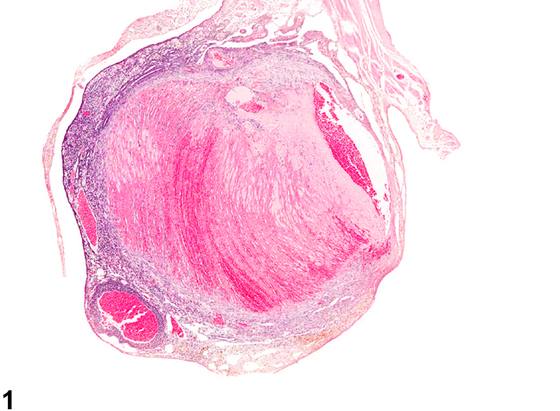
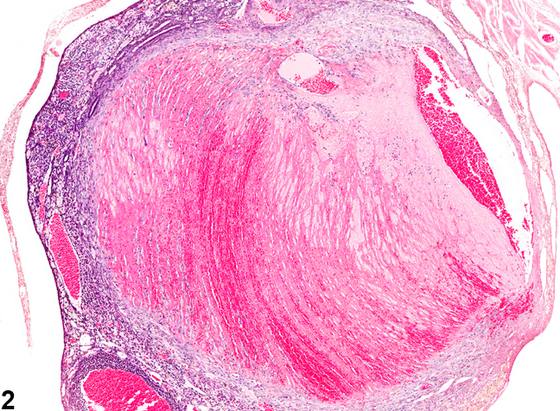
卵巢血栓(Figure 1、Figure 2)可能较大,并由嗜酸性层状物质取代卵巢实质而形成边界清楚的区域。明显的层状结构(Zahn线)由血小板与染色较深的纤维蛋白交替层构成,其间被主要含红细胞的较深层次分隔。在血栓附着于血管壁的周边部位,可见浸润的成纤维细胞和少量炎症细胞。邻近实质受压。存在时间较长的血栓其特征为Zahn线不明显,且常含有符合矿化的无定形嗜碱性物质团块。三个因素易致血栓形成:内皮损伤、正常血流改变以及血液高凝性改变。内皮损伤可能由创伤、感染、辐射、免疫介导性损伤以及细菌毒素或内毒素引起。血流改变可能发生于因炎症、动脉粥样硬化、中膜矿化或中膜肥厚等过程而狭窄的血管中,这些过程促成淤滞或湍流,使血小板与内皮接触,和/或减慢凝血因子抑制物的流入。血液凝固性改变(即高凝状态)并非血栓形成的常见原因。然而,它们可能由凝血蛋白的遗传缺陷所致,或继发于全身性疾病(例如淋巴瘤、炎症、肾脏疾病)。
诊断与分级建议(NTP 共识)
卵巢 - 血栓形成应予以诊断,但无需分级。继发于血栓形成的坏死应单独诊断并分级。其他被认为继发于血栓形成的病变(例如矿化)不应单独诊断,除非其严重程度足以支持这样做。
图谱
英文原文
展开 NTP 官方英文描述与建议
Comment:
Ovarian thrombi ( Figure 1 and Figure 2 ) may be large and comprise well-circumscribed areas of ovarian parenchyma that have been replaced by eosinophilic laminated material. The apparent laminations (lines of Zahn) are produced by alternating layers of platelets admixed with darker-staining fibrin, separated by darker layers containing mainly erythrocytes. Peripherally, at the attachment of the thrombus to the vessel wall, there are infiltrating fibroblasts and small numbers of inflammatory cells. There is compression of the adjacent parenchyma. Thrombi of longer duration are characterized by having less prominent lines of Zahn and often have clumps of amorphous basophilic material consistent with mineralization. Three factors predispose to thrombosis: injury to endothelium, alterations in normal blood flow, and alterations in blood hypercoagulability. Endothelial injury may be due to trauma, infections, radiation, immune-mediated injuries, and bacterial toxins or endotoxins. Alterations in blood flow may occur in vessels narrowed by processes such as inflammation, atherosclerosis, medial mineralization, or medial hypertrophy that contribute to stasis or turbulence, which brings platelets into contact with the endothelium, and/or slow the inflow of clotting factor inhibitors. Alterations in blood coagulability (i.e., hypercoagulability) are not a common cause of thrombosis. However, they can be due to genetic defects in a coagulation protein or could be secondary to systemic disease (e.g., lymphoma, inflammation, renal disease).
Recommendation:
Ovary - Thrombosis should be diagnosed but need not be graded. Necrosis secondary to thrombosis should be diagnosed and graded separately. Other lesions considered to be secondary to thrombosis (e.g., mineralization) should not be diagnosed separately unless warranted by severity.
来源与引用
原始条目:https://ntp.niehs.nih.gov/atlas/nnl/reproductive-system-female/ovary/Thrombosis
图谱总目录:NTP Nonneoplastic Lesion Atlas。 内容属美国联邦政府作品(公有领域),可引用;引用时请标注来源。
建议引用格式:NTP Nonneoplastic Lesion Atlas. Thrombosis (ovary). LabSmart 中文版:
https://www.labsmart.cn/ntp/ovary-thrombosis.html
中文图谱总页(可展开对照全部 595 条):https://www.labsmart.cn/ntp-atlas.html#ovary-thrombosis