增生Hyperplasia · 唾液腺 · 消化系统 · NTP ntp-0233
诊断要点:唾液腺增生一经出现即应诊断并分级。若增生仅限于导管或仅限于腺泡,则诊断中应包含相应的部位修饰词(duct 或 acinus)。
病变描述
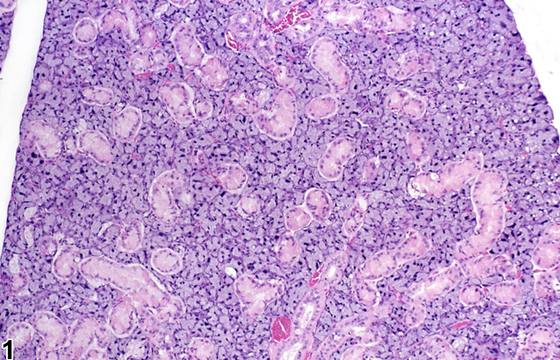
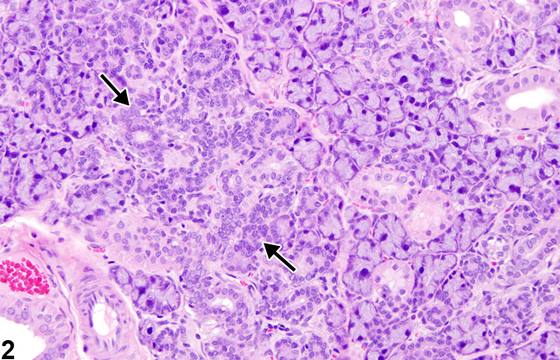
唾液腺增生(hyperplasia)可为腺泡性(acinar)、导管性(ductal)(Figure 2、Figure 4、Figure 5、Figure 6),或两者兼有。腺泡增生导致单个腺泡单位增多,但导管不增多;而导管增生则描述为导管增多,不伴有腺泡结构的同时增多。导管增生常发生于已遭受组织损伤的唾液腺,并表现为一种再生过程(Figure 5、Figure 6)。它是啮齿类动物、犬、猴及人类唾液腺多种炎症性和反应性病变的共同特征,并可与导管系统内结石和结石(calculi)的存在相关。导管上皮的再生性增生见于感染涎泪腺炎病毒(sialodacryoadenitis virus)的大鼠。唾液腺导管增生也可发生于 Wistar 大鼠舌下腺的导管中,而无明显的涎泪腺炎或任何特定疾病的证据。
诊断与分级建议(NTP 共识)
唾液腺增生一经出现即应诊断并分级。若增生仅限于导管或仅限于腺泡,则诊断中应包含相应的部位修饰词(duct 或 acinus)。若导管和腺泡均增生,则不应使用部位修饰词,但应在病理描述中明确说明两种成分均受累。当增生发生于腺体已有组织损伤的区域时,可在增生诊断中加用修饰词“regenerative”。严重程度分级依据腺体(小叶)的大小或受累的增生腺体或导管的数量。相关病变如炎症、纤维化或坏死不应单独诊断,除非其严重程度足以支持单独诊断。
图谱
英文原文
展开 NTP 官方英文描述与建议
Comment:
Hyperplasia of the salivary gland can be acinar, ductal ( Figure 2 , Figure 4 , Figure 5 , and Figure 6 ), or both. Hyperplasia of acini results in an increase in individual acinar units but not in ducts, whereas hyperplasia of the ducts is described as an increase in ducts without a concomitant increase in acinar structures. Often duct hyperplasia occurs in a salivary gland that has undergone tissue damage and appears to be a regenerative process ( Figure 5 and Figure 6 ). It is a common feature of many inflammatory and reactive conditions in the salivary glands of rodents, dogs, monkeys, and humans and can be associated with the presence of stones and calculi within the duct system. Regenerative hyperplasia of the ductal epithelium occurs in rats infected with the sialodacryoadenitis virus. Salivary duct hyperplasia can also be located in the ducts of the sublingual glands in the Wistar rat in the absence of obvious sialodacryoadenitis or evidence of any specific disease.
Recommendation:
Hyperplasia of the salivary gland should be diagnosed and graded whenever present. If the hyperplasia is limited to the ducts or to the acini, then the appropriate site modifier (duct or acinus) should be included in the diagnosis. If both the ducts and acini are hyperplastic, then no site modifier should be used, but it should be made clear in the pathology narrative that both components are affected. The modifier "regenerative" can be added to the hyperplasia diagnosis when the hyperplasia is occurring in areas of the gland in which there has been tissue damage. Severity grading is based on the size of the gland (lobules) or number of hyperplastic glands or ducts affected. Associated lesions such as inflammation, fibrosis, or necrosis should not be diagnosed separately unless warranted by severity.
来源与引用
原始条目:https://ntp.niehs.nih.gov/atlas/nnl/alimentary-system/salivary-gland/Hyperplasia
图谱总目录:NTP Nonneoplastic Lesion Atlas。 内容属美国联邦政府作品(公有领域),可引用;引用时请标注来源。
建议引用格式:NTP Nonneoplastic Lesion Atlas. Hyperplasia (salivary-gland). LabSmart 中文版:
https://www.labsmart.cn/ntp/salivary-gland-hyperplasia.html
中文图谱总页(可展开对照全部 595 条):https://www.labsmart.cn/ntp-atlas.html#salivary-gland-hyperplasia