非典型残余体Atypical Residual Bodies · 睾丸 · 雄性生殖系统 · NTP ntp-0479
诊断要点:非典型残余体应予以诊断并分级,并且如果其发生率和/或严重程度似乎与化学物给予相关,应在病理学叙述中加以讨论。
病变描述
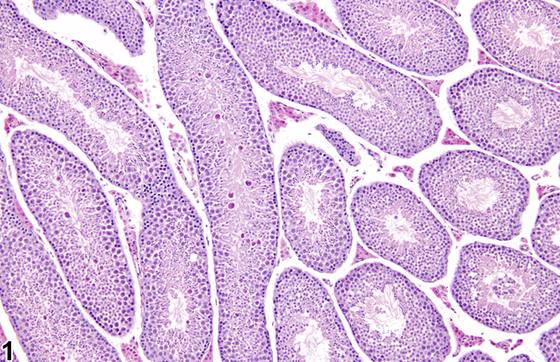
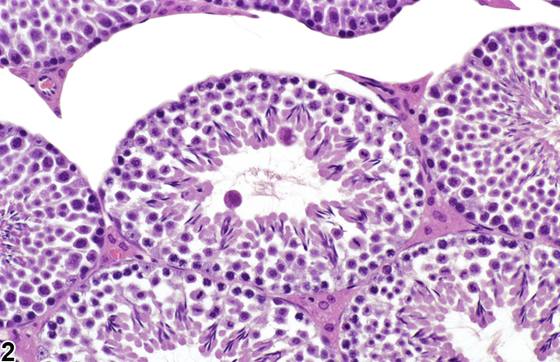
残余体(residual bodies)是致密嗜碱性、球状的体,由延长的精子细胞在成熟最后阶段脱落的冗余细胞器和多余细胞质组成。它们通常见于VII期和VIII期生精小管的管腔表面,与成熟精子细胞的头部混杂在一起。一旦精子释放(spermiation)发生,残余体迅速下降至IX期和X期生精小管的基底部区域,在那里被吞噬并消失。异常大的残余体有时可见于小鼠,作为偶然的背景性发现,或见于小鼠和大鼠,作为化学诱导的退行性改变。非典型残余体通常比正常者大,并具有凋亡小体(apoptotic bodies)的外观(Figure 1、Figure 2、Figure 3、Figure 4)。它们通常位于管腔表面或悬浮于生精小管管腔中,有时可见于正常残余体从不出现的生精小管期别(Figure 2)。其意义尚不清楚,但它们可能代表精子释放过程的紊乱。在大鼠中,已有描述其发生于给予磷酸三邻甲苯酯(tri-o-cresyl phosphate)和水消毒剂化学物二溴乙酸(dibromoacetic acid)之后。
诊断与分级建议(NTP 共识)
非典型残余体应予以诊断并分级,并且如果其发生率和/或严重程度似乎与化学物给予相关,应在病理学叙述中加以讨论。出现双侧受累时应予以诊断。
图谱
英文原文
展开 NTP 官方英文描述与建议
Comment:
Residual bodies are dense basophilic, globular bodies comprising redundant organelles and excess cytoplasm shed from the elongating spermatid in its final steps of maturation. They are generally seen at the luminal surface of stage VII and VIII tubules intermixed with the heads of the mature spermatids. Once spermiation has occurred, the residual bodies rapidly descend to the basal region of the stage IX and X tubule, where they are phagocytized and disappear. Abnormally large residual bodies can sometimes be seen as an incidental background finding in mice or as a chemically induced degenerative change in mice and rats. Atypical residual bodies are generally larger than normal and have the appearance of apoptotic bodies ( Figure 1 , Figure 2 , Figure 3 , and Figure 4 ). They are generally at the luminal surface or appear suspended in the lumen of tubules and can sometimes be seen in tubular stages where normal residual bodies are never present ( Figure 2 ). Their significance is unclear, but they probably represent a disruption of the spermiation process. They have been described in rats in response to administration of tri-o-cresyl phosphate and the water disinfectant chemical dibromoacetic acid.
Recommendation:
Atypical residual bodies should be diagnosed and graded and should be discussed in the pathology narrative if the incidence and/or severity appears to be related to chemical administration. Bilateral involvement should be diagnosed when present.
来源与引用
原始条目:https://ntp.niehs.nih.gov/atlas/nnl/reproductive-system-male/testis/AtypicalResidualBodies
图谱总目录:NTP Nonneoplastic Lesion Atlas。 内容属美国联邦政府作品(公有领域),可引用;引用时请标注来源。
建议引用格式:NTP Nonneoplastic Lesion Atlas. Atypical Residual Bodies (testis). LabSmart 中文版:
https://www.labsmart.cn/ntp/testis-atypical-residual-bodies.html
中文图谱总页(可展开对照全部 595 条):https://www.labsmart.cn/ntp-atlas.html#testis-atypical-residual-bodies