生精小管精子细胞滞留Seminiferous Tubule Retention Spermatid · 睾丸 · 雄性生殖系统 · NTP ntp-0467
诊断要点:如果发生率或严重程度似乎与化学物给药相关,则应诊断精子细胞滞留并进行分级,且应在病理学叙述中加以讨论。
病变描述
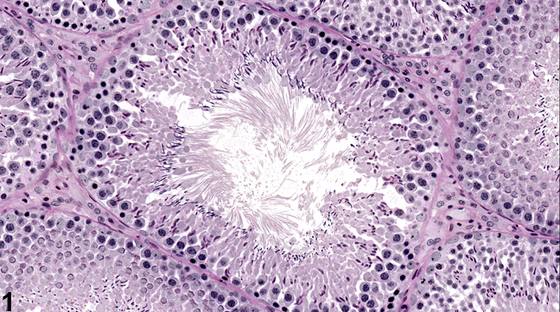
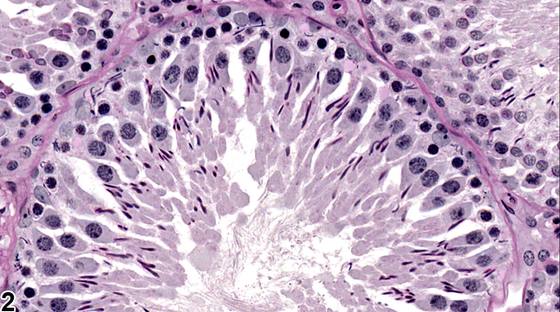
精子释放(spermiation,即完全成熟的精子细胞释放入管腔)在大鼠和小鼠中通常发生于生精周期的VIII期。多种毒物已被证实可干扰精子释放,导致成熟精子细胞(大鼠为第19步精子细胞,小鼠为第17步)持续存在于IX-XI期生精小管的腔面(Figure 1、Figure 2)。滞留的精子细胞随后被拉入基底部的Sertoli细胞胞质内,并在该处被吞噬。已有报道显示,暴露于多种化学物后可出现精子细胞滞留,包括硼酸(boric acid)、2,5-己二酮(2,5-hexanedione)和二溴乙酸(dibromoacetic acid)。精子释放依赖于睾酮(testosterone),因此当睾丸内睾酮水平降低时也会发生精子细胞滞留。尽管该表现较为细微,但识别并记录它很重要,因为它通常会导致附睾精子计数减少、精子异常以及对生育力的潜在影响。在IX期生精小管的管腔处或XII期生精小管基底部被吞噬处,常可见少量滞留的精子细胞,但一般数量很少,且仅限于一两个生精小管。
诊断与分级建议(NTP 共识)
如果发生率或严重程度似乎与化学物给药相关,则应诊断精子细胞滞留并进行分级,且应在病理学叙述中加以讨论。出现双侧受累时应予以诊断。
图谱
英文原文
展开 NTP 官方英文描述与建议
Comment:
Spermiation (the release of fully mature spermatids into the tubular lumen) normally occurs during stage VIII of the spermatogenic cycle in rats and mice. Numerous toxicants have been shown to disrupt spermiation, resulting in the continued presence of the mature spermatids (step 19 spermatids in the rat, step 17 in the mouse) at the luminal surface of stage IX-XI tubules ( Figure 1 and Figure 2 ). The retained spermatids are then pulled down into the basal Sertoli cell cytoplasm, where they are phagocytized. Spermatid retention has been described following exposure to a number of chemicals, including boric acid, 2,5-hexanedione, and dibromoacetic acid. Spermiation is testosterone dependant, so spermatid retention also occurs with decreased intratesticular levels of testosterone. Although subtle, this finding is important to recognize and record since it usually results in reduced epididymal sperm count, sperm abnormalities, and potential effects on fertility. A few retained spermatids can often be seen at the lumen of stage IX tubules or phagocytized at the base of stage XII tubules, but they are generally very few in number and restricted to one or two tubules.
Recommendation:
Spermatid retention should be diagnosed and graded and should be discussed in the pathology narrative if the incidence and/or severity appears to be related to chemical administration. Bilateral involvement should be diagnosed when present.
来源与引用
图谱总目录:NTP Nonneoplastic Lesion Atlas。 内容属美国联邦政府作品(公有领域),可引用;引用时请标注来源。
建议引用格式:NTP Nonneoplastic Lesion Atlas. Seminiferous Tubule Retention Spermatid (testis). LabSmart 中文版:
https://www.labsmart.cn/ntp/testis-seminiferous-tubule-retention-spermatid.html
中文图谱总页(可展开对照全部 595 条):https://www.labsmart.cn/ntp-atlas.html#testis-seminiferous-tubule-retention-spermatid