炎症Inflammation · 骨 · 骨骼肌肉系统 · NTP ntp-0574
诊断要点:骨炎症应被诊断并给予严重程度分级。炎症的性质(化脓性、肉芽肿性等)应作为诊断的一部分。
病变描述
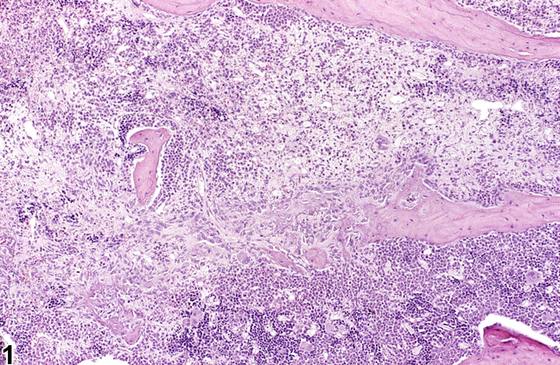
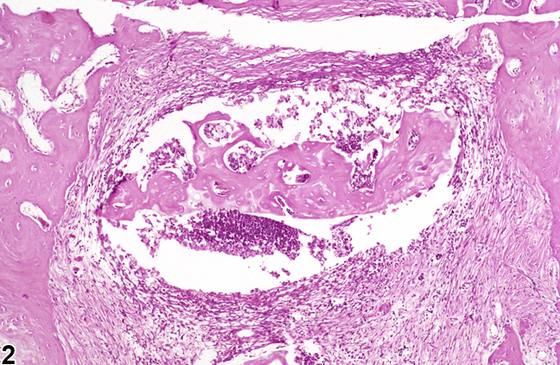
在B6C3F1/N小鼠和F344/N大鼠中,骨炎症(骨髓炎、骨炎)不常见。在啮齿类动物中,骨炎症通常由创伤(如穿透性伤口或骨折)、中耳炎或鼻窦炎导致的细菌感染引起。骨膜及邻近骨的炎症(骨膜炎)可发生于皮肤溃疡下方的区域,且常与反应性骨增生和肉芽组织相关。在许多病例中,骨炎症(尤其与葡萄球菌感染相关)与明显的局部骨吸收(Figure 1、Figure 2)相关,这是由细菌因素和破骨细胞活性增加所致,同时病变边缘出现区域性反应性骨反应和骨质增生性骨反应,以试图局限化炎症过程。将反应性骨增生和重塑过程与 underlying neoplasm 相区分通常可能较为困难。与肿瘤性骨不同,反应性骨排列有序,骨小梁垂直于邻近成熟皮质骨排列并彼此平行(Figure 3)。在反应性骨中,成骨细胞规律地散布于骨小梁表面。骨炎症的类型可能取决于病因和慢性程度。在NTP研究中,炎症有五个标准类别:急性(急性(acute))、化脓性(化脓性(suppurative))、慢性(慢性(chronic))、慢性活动性(慢性活动性(chronic-active))和肉芽肿性(肉芽肿性(granulomatous))。在急性炎症中,主要浸润细胞为中性粒细胞,但也可能存在较少的巨噬细胞和淋巴细胞。还可能有水肿或充血的表现。中性粒细胞也是化脓性炎症中的主要浸润细胞类型,但中性粒细胞聚集,其中许多发生退变(化脓性渗出物)。渗出物中还可能存在驻留细胞群体和浸润白细胞的细胞碎片;含纤维蛋白、巨噬细胞、淋巴细胞和/或浆细胞的蛋白性液体;以及可能的感染因子。肉眼观察,这些病变以脓液存在为特征。在渗出物周围组织中,可能存在成纤维细胞、纤维结缔组织和混合性炎症细胞群体,取决于病变的慢性程度。慢性和慢性活动性炎症由成纤维细胞或纤维化的存在来确定。在慢性炎症中,主要炎症细胞通常为淋巴细胞,而慢性活动性炎症则具有淋巴细胞和中性粒细胞的混合。两种病变也可能含有巨噬细胞。然而,正是成纤维细胞或纤维化的存在决定了病变的慢性性质。肉芽肿性炎症是慢性炎症的另一种形式,但该诊断要求存在大量聚集的、大的活化巨噬细胞、上皮样巨噬细胞或多核巨细胞。在细菌感染在骨中确立的病例中,化脓性炎症和坏死细胞碎片常被局限化为脓肿或死骨片,以试图将炎症/感染过程包裹隔离(Figure 2)。在良好实验室规范条件下的常规毒性和致癌性生物测定中,骨炎症通常不被观察为对毒理学暴露的反应。然而,如果观察到骨髓炎发生率增加,这可能表明动物饲养管理存在问题。此外,任何引起严重免疫抑制的化合物都可能影响动物对共生病原体作出反应的能力,从而增加感染的易感性。
诊断与分级建议(NTP 共识)
骨炎症应被诊断并给予严重程度分级。炎症的性质(化脓性、肉芽肿性等)应作为诊断的一部分。如果骨炎症与原发性创伤性损伤(如骨折、穿透性伤口)或原发性骨肿瘤同时观察到,则不应诊断,而应在叙述中描述为原发性病变的组成部分。然而,在慢性炎症已导致明显骨吸收和骨量减少并继发骨折的病例中,炎症应记录为原发性诊断,并在叙述中描述明显骨吸收的继发效应。当与其他全身性炎症病变、尤其是化脓性病变(脓肿)一致地被识别时,应记录病变谱作为全身性状况并在叙述中描述。如果骨炎症与处理相关,则应在病理学叙述中确定受影响的骨。
图谱
英文原文
展开 NTP 官方英文描述与建议
Comment:
Inflammation of the bone (osteomyelitis, osteitis) is uncommon in the B6C3F1/N mouse and F344/N rat. In rodents, inflammation of the bone is typically due to bacterial infection as a result of trauma, such as penetrating wounds or fracture, otitis media, or sinusitis. Inflammation of the periosteum (periostitis) and adjacent bone may occur in regions subjacent to ulceration of the skin and is often associated with reactive bone proliferation and granulation tissue. In many cases, inflammation of the bone (especially associated with staphylococcal infection) is associated with marked localized bone resorption ( Figure 1 and Figure 2 ) due to bacterial factors and increased osteoclastic activity, as well as regional reactive and hyperostotic bone response at the lesion margin as an attempt to localize the inflammatory process. Distinguishing hyperplasia of reactive bone and remodeling processes from an underlying neoplasm often may be difficult. In contrast to neoplastic bone, reactive bone is arranged in an orderly pattern, with bony trabeculae arranged perpendicular to the adjacent mature cortical bone and parallel to each other ( Figure 3 ). In reactive bone, osteoblasts are regularly interspersed along the surface of trabeculae. The type of inflammation in bone may depend on the cause and chronicity. In NTP studies, there are five standard categories of inflammation: acute, suppurative, chronic, chronic-active, and granulomatous. In acute inflammation , the predominant infiltrating cell is the neutrophil, though fewer macrophages and lymphocytes may also be present. There may also be evidence of edema or hyperemia. The neutrophil is also the predominant infiltrating cell type in suppurative inflammation , but the neutrophils are aggregated, and many of them are degenerate (suppurative exudate). Cell debris from the resident cell populations and infiltrating leukocytes; proteinic fluid containing fibrin, macrophages, lymphocytes, and/or plasma cells; and possibly an infectious agent may also be present within the exudate. Grossly, these lesions would be characterized by the presence of pus. In the tissue surrounding the exudate, there may be fibroblasts, fibrous connective tissue, and a mixed population of inflammatory cells, depending on the chronicity of the lesion. Chronic and chronic-active inflammation is determined by the presence of fibroblasts or fibrosis. With chronic inflammation , the predominant inflammatory cell is usually the lymphocyte, whereas chronic-active inflammation has a mixture of lymphocytes and neutrophils. Both lesions may also contain macrophages. However, it is the presence of fibroblasts or fibrosis that determines the chronic nature of the lesion. Granulomatous inflammation is another form of chronic inflammation, but this diagnosis requires the presence of a significant number of aggregated, large, activated macrophages, epithelioid macrophages, or multinucleated giant cells. In cases in which a bacterial infection becomes established in the bone, suppurative inflammation and necrotic cellular debris are often localized as an abscess or sequestrum in an attempt to wall off the inflammatory/infectious process ( Figure 2 ). Inflammation of the bone is not typically observed as a response to toxicologic exposures in routine toxicity and carcinogenicity bioassays under Good Laboratory Practice conditions. However, if increased incidences of osteomyelitis are observed, this may indicate issues with animal husbandry. In addition, any compound causing profound immunosuppression may impact an animal’s ability to respond to commensal pathogens, thus increasing susceptibility to infection.
Recommendation:
Inflammation of bone should be diagnosed and given a severity grade. The character of inflammation (suppurative, granulomatous, etc.) should be part of the diagnosis. If inflammation of the bone is observed in conjunction with a primary traumatic injury (e.g., fracture, penetrating wound) or primary bone tumor, it should not be diagnosed but should be described in the narrative as a component of the primary lesion. However, in cases in which chronic inflammation has led to marked bony resorption and osteopenia with secondary fracture, inflammation should be recorded as the primary diagnosis, with a description of the secondary effects of marked bone resorption provided in the narrative. When recognized in concordance with other systemic inflammatory lesions, especially suppurative lesions (abscesses), the spectrum of lesions as a systemic condition should be recorded and described in the narrative. If inflammation of the bone is associated with treatment, the bones affected should be identified in the pathology narrative.
来源与引用
原始条目:https://ntp.niehs.nih.gov/atlas/nnl/musculoskeletal-system/bone/Inflammation
图谱总目录:NTP Nonneoplastic Lesion Atlas。 内容属美国联邦政府作品(公有领域),可引用;引用时请标注来源。
建议引用格式:NTP Nonneoplastic Lesion Atlas. Inflammation (bone). LabSmart 中文版:
https://www.labsmart.cn/ntp/bone-inflammation.html
中文图谱总页(可展开对照全部 595 条):https://www.labsmart.cn/ntp-atlas.html#bone-inflammation