关节变性Joint Degeneration · 骨 · 骨骼肌肉系统 · NTP ntp-0569
诊断要点:退行性关节病/骨关节炎应诊断为“骨,关节-退行性变”并给出严重程度分级。不必记录所有各个组成部分,但若该病似乎与化学物暴露相关,则应在叙述中予以描述。
病变描述
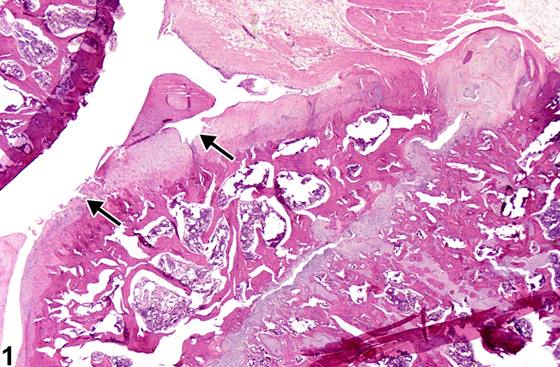
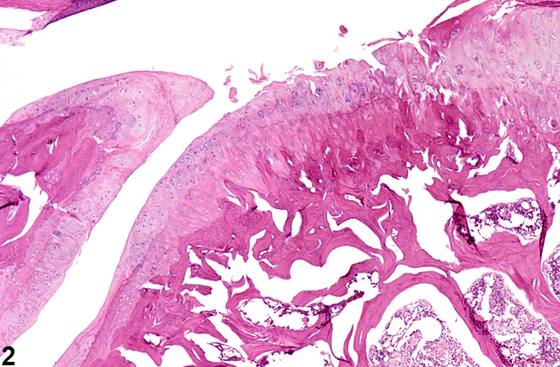
关节退行性变(骨关节炎、关节病、骨关节病、退行性关节病)是一种非炎症性、进行性软骨疾病,其特征为关节软骨丢失、软骨下骨增厚(Figure 1)及囊肿形成,并在受累关节间隙内形成骨赘。骨关节炎的早期病变包括软骨染色性质改变,表现为软骨基质嗜碱性丧失及纤维状质地(由黏多糖丢失所致)、裂隙形成以及软骨肥大和增生,后者表现为排列不规则的增大软骨细胞簇。严重病变可伴有软骨裂隙(Figure 2),导致软骨侵蚀和丢失、关节囊和滑膜增厚(Figure 3),以及骨赘形成和软骨下骨囊肿形成。滑膜组织可变厚,伴绒毛状突起自滑膜发出并突入关节间隙。随着病程慢性化,滑膜可发生软骨性或骨性化生。严重病例可发生关节强直(融合)。超微结构上,退行性变的特征为高尔基体异常、细胞内微丝增多、蛋白聚糖颗粒数量减少以及软骨基质内胶原破坏。退行性关节病作为衰老过程的一个组成部分,几乎发生于所有品系的大鼠和小鼠。在B6C3F1 mouse中,该病在雄性中的发生率高于雌性,膝关节的发病率雄性高达2%、雌性高达4%。已知该病在小鼠中优先累及膝关节和肘关节,但也发生于胸椎远端椎骨和胸骨关节。在F344 rat中,已有报道自13月龄起即出现自发病变。尽管这是一种正常的年龄相关变化,但该病为多因素所致,除暴露于各种可导致软骨基质改变的毒物外,还受饮食、品系、性激素和体重的影响。大鼠关节软骨或生长板的软骨黏液样/囊性变性(无菌性坏死)不应与退行性关节病混淆。这是老年大鼠常见的自发病变,可导致骺板和骨骺骨小梁自发性骨折,但不引起关节软骨的退行性病变。
诊断与分级建议(NTP 共识)
退行性关节病/骨关节炎应诊断为“骨,关节-退行性变”并给出严重程度分级。不必记录所有各个组成部分,但若该病似乎与化学物暴露相关,则应在叙述中予以描述。在叙述中,如适当,可使用“退行性关节病”或“骨关节炎”这些术语来指代与形态学相关的该病。相关链接:骨-关节-炎症
图谱
英文原文
展开 NTP 官方英文描述与建议
Comment:
Degeneration of the joint (osteoarthritis arthrosis, osteoarthrosis, osteoarthropathy, degenerative joint disease) is a noninflammatory, progressive disease of cartilage characterized by loss of articular cartilage, subchondral bone thickening ( Figure 1 ) and cyst formation, and formation of osteophytes within the affected joint space. Early lesions of osteoarthritis consist of tinctorial alterations of the cartilage characterized by loss of basophilia and fibrillar consistency (resulting from loss of mucopolysaccharides) of the cartilaginous matrix, fissure formation, and hypertrophy and hyperplasia of cartilage, evidenced by irregularly arranged clusters of enlarged chondrocytes. Severe lesions may be associated with cartilaginous clefts ( Figure 2 ), leading to erosion and loss, thickening of the joint capsule and synovium ( Figure 3 ), and osteophytosis and subchondral bone cyst formation. Synovial tissue may become thickened, with villous projections emanating from the synovium and protruding into the joint space. With chronicity, the synovium may undergo cartilaginous or bony metaplasia. In severe cases, ankylosis (fusion) of the joint may occur. Ultrastructurally, degenerative changes are characterized by abnormal Golgi, increased intracellular microfilaments, decreased numbers of proteoglycan granules, and disruption of collagen within the cartilaginous matrix. Degenerative joint disease occurs in nearly all strains of rats and mice as a component of the aging process. In the B6C3F1 mouse, the disease occurs more commonly in males than females and has an incidence in the stifle joint of up to 2% for males and 4% for females. The disease is known to preferentially affect the stifle and elbow joints in the mouse but also occurs in the distal thoracic vertebrae and joints of the sternum. In the F344 rat, spontaneous lesions have been reported as early as 13 months. Although a normal age-related change, the disease is multifactorial and influenced by diet, strain, sex hormones, and weight, in addition to exposure to various toxicants, which can cause alterations in the cartilaginous matrix. Chondromucinous/cystic degeneration (aseptic necrosis) of articular cartilage or growth plates in the rat should not be confused with degenerative joint disease. This is a common spontaneous lesion in aged rats that may lead to spontaneous fractures of bony trabeculae of the physis and epiphysis but does not cause degenerative lesions of the articular cartilage.
Recommendation:
Degenerative joint disease/osteoarthritis should be diagnosed as "Bone, Joint – Degeneration" and given a severity grade. It is not necessary to record all of the individual components, but they should be described in the narrative if the disease appears correlated with chemical exposure. In the narrative, the terms "degenerative joint disease" or "osteoarthritis" may be used to connote the disease associated with the morphology, if appropriate. Related Links: Bone - Joint - Inflammation
来源与引用
原始条目:https://ntp.niehs.nih.gov/atlas/nnl/musculoskeletal-system/bone/Joint-Degeneration
图谱总目录:NTP Nonneoplastic Lesion Atlas。 内容属美国联邦政府作品(公有领域),可引用;引用时请标注来源。
建议引用格式:NTP Nonneoplastic Lesion Atlas. Joint Degeneration (bone). LabSmart 中文版:
https://www.labsmart.cn/ntp/bone-joint-degeneration.html
中文图谱总页(可展开对照全部 595 条):https://www.labsmart.cn/ntp-atlas.html#bone-joint-degeneration