淀粉样物质Amyloid · 肾脏 · 泌尿系统 · NTP ntp-0157
诊断要点:淀粉样物质应当被诊断并分级。应使用部位修饰词在诊断中指明淀粉样物质沉积的位置。任何继发性病变,如坏死或变性,除非因严重程度而有必要,否则不应单独诊断。
病变描述
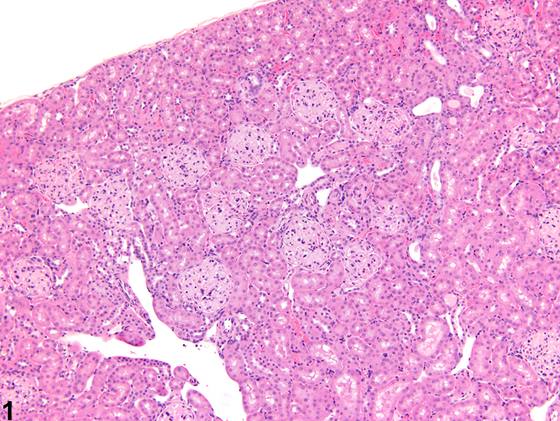
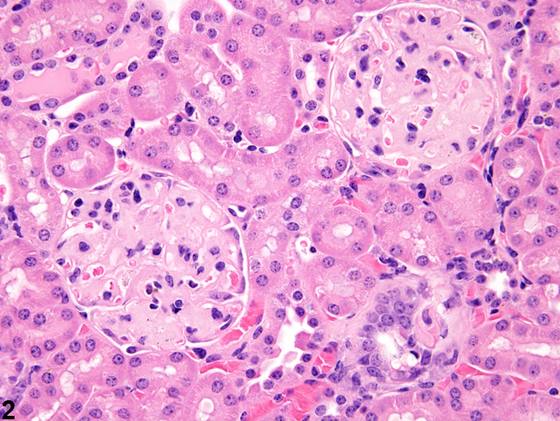
淀粉样物质沉积(amyloid deposition)是一种自发性的、与年龄相关的疾病,偶尔可能与受试物给药有关。该病变在小鼠的某些品系中常见,尤其是 CD-1 小鼠,但在大鼠中罕有报道或观察到。淀粉样物质最常见的表现是肾小球内出现淡染、均质、略嗜酸性的细胞外沉积物(Figure 1、Figure 2、Figure 3)。然而,淀粉样物质也可在小管周围间质间隙中被识别。常使用特殊染色来鉴定淀粉样物质,包括刚果红(Congo red)染色阳性并在偏振光下呈现苹果绿双折射(Figure 4、Figure 5、Figure 6),以及过碘酸-雪夫(PAS)染色阴性。与其他物种相比,小鼠的淀粉样物质沉积在刚果红染色下似乎呈弱阳性,而其他物种的苹果绿双折射更为明显。淀粉样物质必须与透明样肾小球病(hyaline glomerulopathy)相鉴别,后者是一种形态学相似的小鼠疾病,但发病机制和染色模式不同(见肾脏 - 透明样肾小球病)。淀粉样物质可导致乳头坏死(papillary necrosis)。同时,淀粉样物质沉积可存在于其他器官,如脾脏、肝脏和胃肠道。
诊断与分级建议(NTP 共识)
淀粉样物质应当被诊断并分级。应使用部位修饰词在诊断中指明淀粉样物质沉积的位置。任何继发性病变,如坏死或变性,除非因严重程度而有必要,否则不应单独诊断。然而,继发性病变应在病理学描述中予以描述。相关链接:肾脏 - 透明样肾小球病 肾脏 - 肾小球肾炎 肾脏 - 肾小球硬化 肾脏 - 乳头 - 坏死
图谱
英文原文
展开 NTP 官方英文描述与建议
Comment:
Amyloid deposition is a spontaneous and age-related disease that occasionally can be related to test item administration. It is commonly noted in some strains of mouse, particularly the CD-1 mouse, but is rarely reported or observed in the rat. Amyloid is most commonly noted as an extracellular deposition of pale, homogeneous, slightly eosinophilic material in renal glomeruli ( Figure 1 , Figure 2 , and Figure 3 ). However, amyloid may also be identified in peritubular interstitial spaces. Special stains are often used to identify amyloid, including Congo red positivity with apple green birefringence when polarized ( Figure 4 , Figure 5 , and Figure 6 ) and periodic acid-Schiff negativity. Amyloid deposits in mice seem to be faintly positive with Congo red compared with other species, where apple green birefringence is more pronounced. Amyloid must be distinguished from hyaline glomerulopathy, a morphologically similar disease of mice with a different pathogenesis and staining pattern (see Kidney - Hyaline Glomerulopathy ). Amyloid may result in papillary necrosis. Concurrently, amyloid deposits may be present in other organs, such as the spleen, liver, and gastrointestinal tract.
Recommendation:
Amyloid should be diagnosed and graded. The location of the amyloid deposits should be indicated in the diagnosis by using a site modifier. Any secondary lesions, such as necrosis or degeneration, should not be diagnosed separately unless warranted by severity. Secondary lesions should, however, be described in the pathology narrative. Related Links: Kidney - Hyaline Glomerulopathy Kidney - Glomerulonephritis Kidney - Glomerulosclerosis Kidney - Papilla - Necrosis
来源与引用
原始条目:https://ntp.niehs.nih.gov/atlas/nnl/urinary-system/kidney/Amyloid
图谱总目录:NTP Nonneoplastic Lesion Atlas。 内容属美国联邦政府作品(公有领域),可引用;引用时请标注来源。
建议引用格式:NTP Nonneoplastic Lesion Atlas. Amyloid (kidney). LabSmart 中文版:
https://www.labsmart.cn/ntp/kidney-amyloid.html
中文图谱总页(可展开对照全部 595 条):https://www.labsmart.cn/ntp-atlas.html#kidney-amyloid