肾小管嗜酸性细胞性增生Renal Tubule Hyperplasia Oncocytic · 肾脏 · 泌尿系统 · NTP ntp-0171
诊断要点:嗜酸性细胞增生应作出诊断并给出严重程度分级。相关链接:肾脏 - 肾小管 - 增生,嗜两性-空泡性;
病变描述
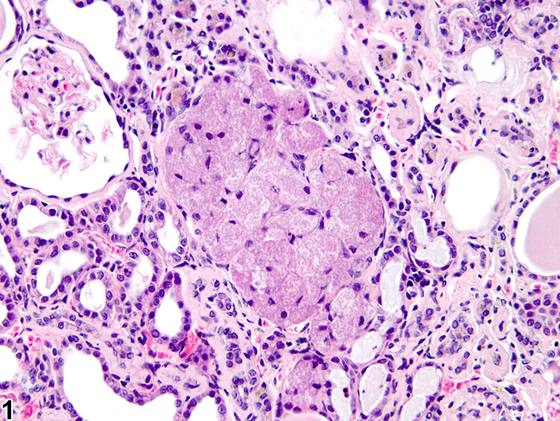
嗜酸性细胞增生(oncocytic hyperplasia)的特征是肾小管细胞胞质淡染、呈细颗粒状,细胞核位于中央。嗜酸性细胞增生在大鼠和小鼠中是一种罕见的病变(Figure 1),据报道起源于集合管。超微结构上,嗜酸性细胞由非典型线粒体构成。嗜酸性细胞增生难以与嗜酸性细胞瘤(oncocytoma)区分,应与其他肾小管增生性病变分别评分。
诊断与分级建议(NTP 共识)
嗜酸性细胞增生应作出诊断并给出严重程度分级。相关链接:肾脏 - 肾小管 - 增生,嗜两性-空泡性;肾脏 - 肾小管 - 非典型肾小管增生
图谱
英文原文
展开 NTP 官方英文描述与建议
Comment:
Oncocytic hyperplasia is characterized by tubule cells having lightly staining and finely granular cytoplasm with centralized nuclei. Oncocytic hyperplasia is a rare lesion in the rat and mouse ( Figure 1 ) and reportedly originates in the collecting tubule. Ultrastructurally, oncocytes are composed of atypical mitochondria. Oncocytic hyperplasia is difficult to separate from oncocytoma and should be scored separately from other hyperplastic lesions of the renal tubule.
Recommendation:
Oncocytic hyperplasia should be diagnosed and given a severity grade. Related Links: Kidney - Renal Tubule - Hyperplasia, Amphophilic-Vacuolar Kidney - Renal Tubule - Atypical Tubule Hyperplasia
来源与引用
原始条目:https://ntp.niehs.nih.gov/atlas/nnl/urinary-system/kidney/RenalTubule-HyperplasiaOncocytic
图谱总目录:NTP Nonneoplastic Lesion Atlas。 内容属美国联邦政府作品(公有领域),可引用;引用时请标注来源。
建议引用格式:NTP Nonneoplastic Lesion Atlas. Renal Tubule Hyperplasia Oncocytic (kidney). LabSmart 中文版:
https://www.labsmart.cn/ntp/kidney-renal-tubule-hyperplasia-oncocytic.html
中文图谱总页(可展开对照全部 595 条):https://www.labsmart.cn/ntp-atlas.html#kidney-renal-tubule-hyperplasia-oncocytic