萎缩Atrophy · 肝 · 肝胆系统 · NTP ntp-0422
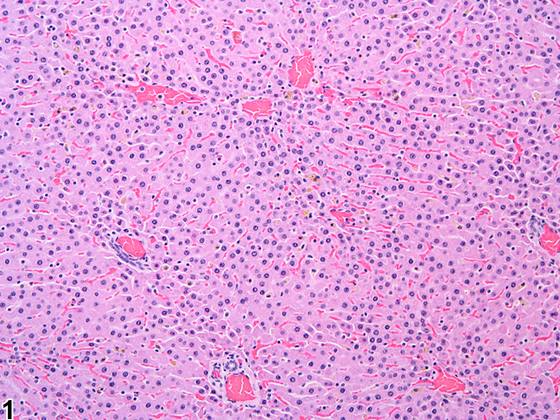
诊断要点:除像本例这样显著的例子外,肝萎缩的诊断是一项困难的形态学判断,可能最好通过器官重量来评估。
病变描述
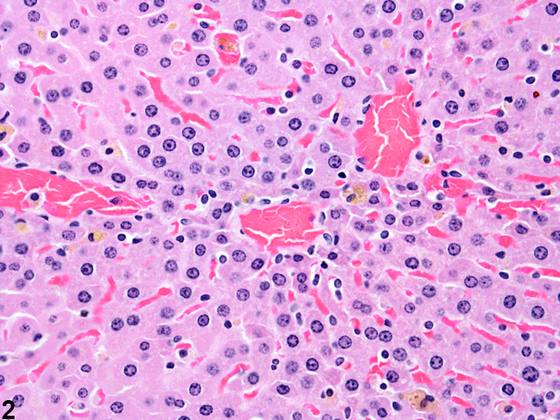
严重热量缺乏以及动物暴露于高剂量外源性化学物质时可出现肝萎缩(hepatic atrophy)。肝细胞及其细胞核体积缩小,细胞核显得排列更为紧密。通常没有糖原蓄积的证据,Kupffer细胞和肝细胞中可能存在代表细胞分解的色素沉着(最可能是脂褐素)(Figure 2)。Figure 3、Figure 4代表正常肝脏。
诊断与分级建议(NTP 共识)
除像本例这样显著的例子外,肝萎缩的诊断是一项困难的形态学判断,可能最好通过器官重量来评估。肝萎缩的分级同样困难。如果确有必要准确记录细微的萎缩性改变,推荐对切片进行盲法评估,将相关剂量组与对照组进行比较。
图谱
英文原文
展开 NTP 官方英文描述与建议
Comment:
Hepatic atrophy is seen with severe caloric deficits as well as when animals are exposed to high doses of xenobiotics. The size of the hepatocytes and their nuclei is reduced, with nuclei appearing more closely spaced. There is typically no evidence of glycogen accumulation, and pigmentation (most likely lipofuscin) representative of cellular breakdown may be present in Kupffer cells and hepatocytes ( Figure 2 ). Figure 3 and Figure 4 represent a normal liver.
Recommendation:
Except in dramatic examples, as in this case, diagnosis of hepatic atrophy is a difficult morphologic determination and may be better assessed by organ weight. Grading of hepatic atrophy is likewise difficult. If it becomes necessary to accurately document subtle atrophic changes, a blind evaluation of the slides comparing the relevant dose groups with controls is recommended.
来源与引用
原始条目:https://ntp.niehs.nih.gov/atlas/nnl/hepatobiliary-system/liver/Atrophy
图谱总目录:NTP Nonneoplastic Lesion Atlas。 内容属美国联邦政府作品(公有领域),可引用;引用时请标注来源。
建议引用格式:NTP Nonneoplastic Lesion Atlas. Atrophy (liver). LabSmart 中文版:
https://www.labsmart.cn/ntp/liver-atrophy.html
中文图谱总页(可展开对照全部 595 条):https://www.labsmart.cn/ntp-atlas.html#liver-atrophy