腮腺嗜碱性肥大灶Parotid Basophilic Hypertrophic Focus · 唾液腺 · 消化系统 · NTP ntp-0245
诊断要点:当存在单个病灶时,应诊断为“嗜碱性肥大灶(basophilic hypertrophic focus)”。
病变描述
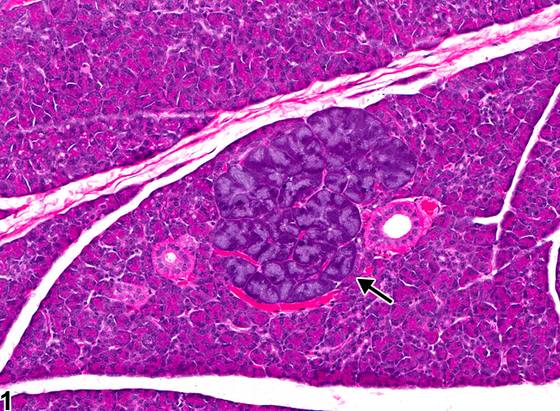
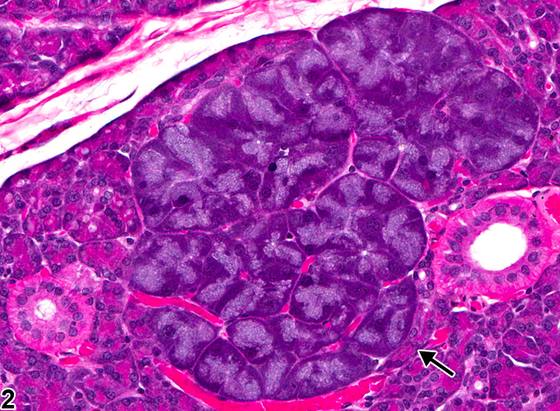
唾液腺的嗜碱性肥大灶(basophilic hypertrophic foci)在小鼠和大鼠中仅见于腮腺,通常为单个发生(Figure 1、Figure 2),尽管也可能观察到多个病灶(Figure 3、Figure 4、Figure 5)。这些病灶由增大的腺泡细胞呈局灶性(focal)簇状聚集构成,细胞内胞质增多,有时细胞核也增大。顶端胞质通常呈空泡化且淡染,而基底部胞质呈深嗜碱性。该变化偶尔可见于未处理的 rat,但包括多西拉敏(doxylamine)在内的化学物质已在 F344 rat 的腮腺中诱导出该变化。该变化不被认为是肿瘤前病变。
诊断与分级建议(NTP 共识)
当存在单个病灶时,应诊断为“嗜碱性肥大灶(basophilic hypertrophic focus)”。多个病灶应诊断为“嗜碱性肥大灶,multiple”。不必进行严重程度分级,但如果病灶大小或数量的增加与化学物质暴露相关,则应采用兼顾每只动物病灶大小和数量的分级标准。
图谱
英文原文
展开 NTP 官方英文描述与建议
Comment:
Basophilic hypertrophic foci of the salivary glands have been found only in the parotid gland in mice and rats and usually occur singly ( Figure 1 and Figure 2 ), although multiple foci may be observed ( Figure 3 , Figure 4 , and Figure 5 ). The foci consist of focal clusters of enlarged acinar cells that contain increased amounts of cytoplasm and, sometimes, enlarged nuclei. The apical cytoplasm is usually vacuolated and pale, while the basilar cytoplasm is deeply basophilic. This change may be seen occasionally in untreated rats, but chemicals, including doxylamine, have produced this change in the parotid gland of F344 rats. This change is not thought to be preneoplastic.
Recommendation:
When a single focus is present, it should be diagnosed as "basophilic hypertrophic focus." Multiple foci should be diagnosed as "basophilic hypertrophic focus, multiple." Severity grading is not necessary, but if an increase in size or number of foci is correlated with chemical exposure, a grading scale should be applied that takes into account both the size and number of foci in each animal.
来源与引用
图谱总目录:NTP Nonneoplastic Lesion Atlas。 内容属美国联邦政府作品(公有领域),可引用;引用时请标注来源。
建议引用格式:NTP Nonneoplastic Lesion Atlas. Parotid Basophilic Hypertrophic Focus (salivary-gland). LabSmart 中文版:
https://www.labsmart.cn/ntp/salivary-gland-parotid-basophilic-hypertrophic-focus.html
中文图谱总页(可展开对照全部 595 条):https://www.labsmart.cn/ntp-atlas.html#salivary-gland-parotid-basophilic-hypertrophic-focus