角化过度Hyperkeratosis · 皮肤 · 皮肤系统 · NTP ntp-0378
诊断要点:只要存在角化过度,就应记录并赋予严重程度分级。由于角化不全是角化过度的一种形式,NTP研究中只应使用“角化过度(hyperkeratosis)”这一术语。
病变描述
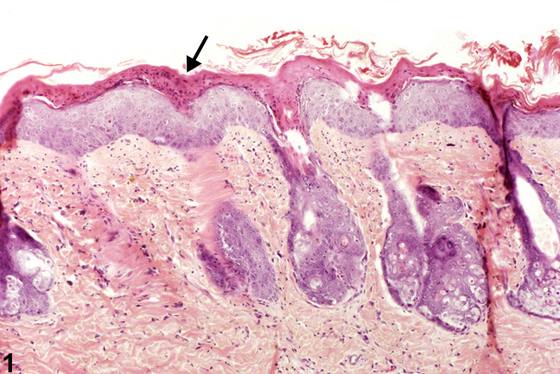
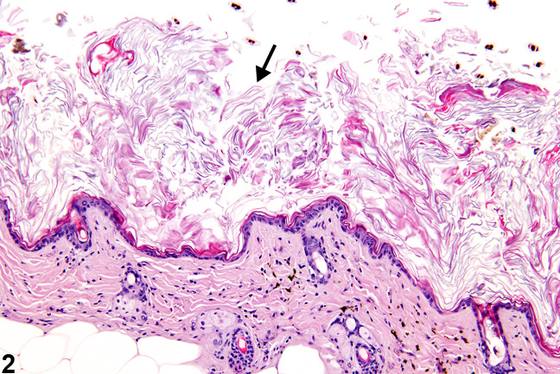
角化过度最常见于皮肤给药研究,并且常伴随上皮增生或继发于上皮增生。其特征为角质层增厚(Figure 1、Figure 2)。角化过度最常见的是正角化性(角质层增厚但无残留细胞核;Figure 2)。角化不全性角化过度的特征为角质层内存在细胞核,罕见发生,并且通常与上皮增生同时存在(Figure 1)。
诊断与分级建议(NTP 共识)
只要存在角化过度,就应记录并赋予严重程度分级。由于角化不全是角化过度的一种形式,NTP研究中只应使用“角化过度(hyperkeratosis)”这一术语。但是,应在病理学描述中说明角化过度是正角化性还是角化不全性。相关病变,如上皮增生和炎症,应单独诊断。
图谱
英文原文
展开 NTP 官方英文描述与建议
Comment:
Hyperkeratosis is most commonly observed in dermal application studies and is often accompanied by or secondary to epithelial hyperplasia. It is characterized by thickening of the stratum corneum ( Figure 1 and Figure 2 ). Hyperkeratosis is most commonly orthokeratotic (thickening of the cornified layer without retained nuclei; Figure 2 ). Parakeratotic hyperkeratosis, which is characterized by the presence of nuclei in the cornified layer, occurs rarely and is usually concurrent with epithelial hyperplasia ( Figure 1 ).
Recommendation:
Whenever present, hyperkeratosis should be recorded and assigned a severity grade. Since parakeratosis is simply a form of hyperkeratosis, only the term “hyperkeratosis” should be used in NTP studies. However, the hyperkeratosis should be described in the pathology narrative as being orthokeratotic or parakeratotic. Associated lesions, such as epithelial hyperplasia and inflammation, should be diagnosed separately.
来源与引用
原始条目:https://ntp.niehs.nih.gov/atlas/nnl/integumentary-system/skin/Hyperkeratosis
图谱总目录:NTP Nonneoplastic Lesion Atlas。 内容属美国联邦政府作品(公有领域),可引用;引用时请标注来源。
建议引用格式:NTP Nonneoplastic Lesion Atlas. Hyperkeratosis (skin). LabSmart 中文版:
https://www.labsmart.cn/ntp/skin-hyperkeratosis.html
中文图谱总页(可展开对照全部 595 条):https://www.labsmart.cn/ntp-atlas.html#skin-hyperkeratosis