矿化Mineralization · 膀胱 · 泌尿系统 · NTP ntp-0196
诊断要点:当矿化在其他病变缺失的情况下出现(例如转移性矿化),或者当其继发于另一过程(例如营养不良性矿化)但构成病变的重要组分时,应当对其作出诊断并给出严重程度分级。
病变描述
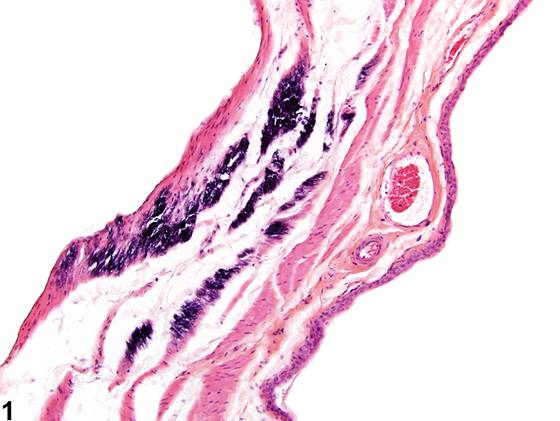
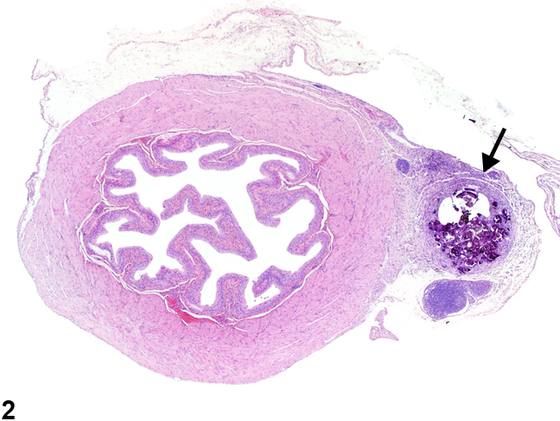
矿化表现为深嗜碱性、颗粒状物质(Figure 1、Figure 2)。它通常累及膀胱的肌壁。营养不良性矿化(dystrophic mineralization)可继发于多种原因,尤其是在坏死区域。转移性矿化(metastatic mineralization)在啮齿类动物的膀胱中不常见。
诊断与分级建议(NTP 共识)
当矿化在其他病变缺失的情况下出现(例如转移性矿化),或者当其继发于另一过程(例如营养不良性矿化)但构成病变的重要组分时,应当对其作出诊断并给出严重程度分级。相关链接:Urinary Bladder - Calculus/Crystal
图谱
英文原文
展开 NTP 官方英文描述与建议
Comment:
Mineralization occurs as densely basophilic, granular material ( Figure 1 and Figure 2 ). It usually involves the muscle wall of the urinary bladder. Dystrophic mineralization may be seen secondary to a variety of causes, especially in areas of necrosis. Metastatic mineralization is uncommon in the rodent bladder.
Recommendation:
Mineralization should be diagnosed and given a severity grade when seen in the absence of other lesions (e.g., metastatic mineralization) or, if it is secondary to another process (e.g., dystrophic mineralization), when it is a significant component of the lesion. Related Links: Urinary Bladder - Calculus/Crystal
来源与引用
原始条目:https://ntp.niehs.nih.gov/atlas/nnl/urinary-system/urinary-bladder/Mineralization
图谱总目录:NTP Nonneoplastic Lesion Atlas。 内容属美国联邦政府作品(公有领域),可引用;引用时请标注来源。
建议引用格式:NTP Nonneoplastic Lesion Atlas. Mineralization (urinary-bladder). LabSmart 中文版:
https://www.labsmart.cn/ntp/urinary-bladder-mineralization.html
中文图谱总页(可展开对照全部 595 条):https://www.labsmart.cn/ntp-atlas.html#urinary-bladder-mineralization