蛋白性栓Proteinaceous Plug · 膀胱 · 泌尿系统 · NTP ntp-0199
诊断要点:单独发生且不与任何病理病变相关的蛋白性栓子应被认定为人为假象,不应作出诊断。偶尔,蛋白性栓子可在肉眼检查中被识别,病理学家应运用其判断力将肉眼病变与人为蛋白性栓子相关联。
病变描述
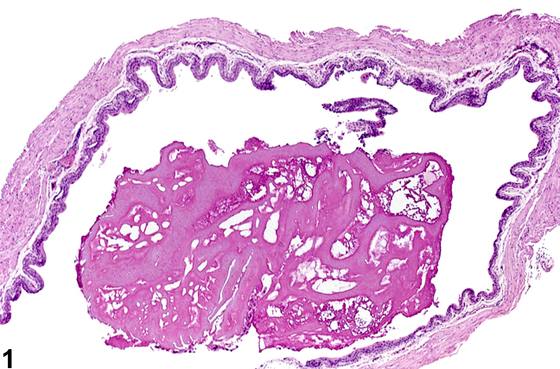
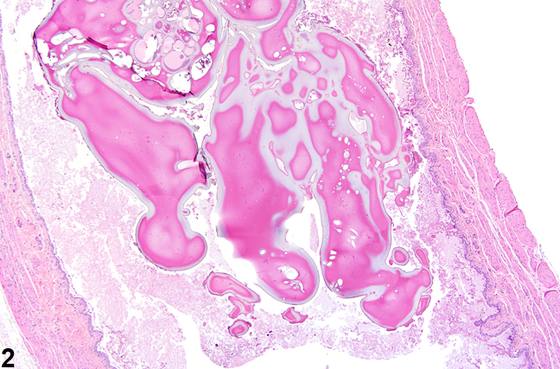
蛋白性栓子通常被认为是濒死期安乐死过程中附属性腺分泌物濒死性分泌所致的死后变化。蛋白性栓子大小不一,但可很大,充满膀胱(Figure 1、Figure 2)。显微镜下,栓子由无定形嗜酸性物质混合构成,有时含有脱落的上皮细胞和精子。蛋白性栓子本身无毒性学意义,也不是结石的前体。栓子可见于与细菌性炎症相关的梗阻综合征。必须与结石相鉴别。
诊断与分级建议(NTP 共识)
单独发生且不与任何病理病变相关的蛋白性栓子应被认定为人为假象,不应作出诊断。偶尔,蛋白性栓子可在肉眼检查中被识别,病理学家应运用其判断力将肉眼病变与人为蛋白性栓子相关联。
图谱
英文原文
展开 NTP 官方英文描述与建议
Comment:
Proteinaceous plugs are commonly noted as a postmortem change resulting from an agonal secretion of accessory sex gland fluids during euthanasia. Proteinaceous plugs vary in size but can be large, filling the urinary bladder ( Figure 1 and Figure 2 ). Microscopically, the plug is composed of a mixture of an amorphous eosinophilic material, sometimes containing desquamated epithelial cells and spermatozoa. Proteinaceous plugs by themselves have no toxicologic importance and are not precursors of calculi. Plugs may be seen with obstructive syndromes associated with bacterial inflammation. They must be differentiated from calculi.
Recommendation:
Proteinaceous plugs occurring alone and not associated with any pathologic lesions should be recognized as an artifact and should not be diagnosed. Occasionally, proteinaceous plugs are recognized grossly, and the pathologist should use his or her judgment to correlate the gross lesion to an artifactual proteinaceous plug.
来源与引用
原始条目:https://ntp.niehs.nih.gov/atlas/nnl/urinary-system/urinary-bladder/ProteinaceousPlug
图谱总目录:NTP Nonneoplastic Lesion Atlas。 内容属美国联邦政府作品(公有领域),可引用;引用时请标注来源。
建议引用格式:NTP Nonneoplastic Lesion Atlas. Proteinaceous Plug (urinary-bladder). LabSmart 中文版:
https://www.labsmart.cn/ntp/urinary-bladder-proteinaceous-plug.html
中文图谱总页(可展开对照全部 595 条):https://www.labsmart.cn/ntp-atlas.html#urinary-bladder-proteinaceous-plug