出血Hemorrhage · 脑 · 神经系统 · NTP ntp-0382
诊断要点:在NTP研究中出现时,应诊断出血并确定其位置和严重程度。存在并发病变时,通常诊断严重程度最高的病变。
病变描述
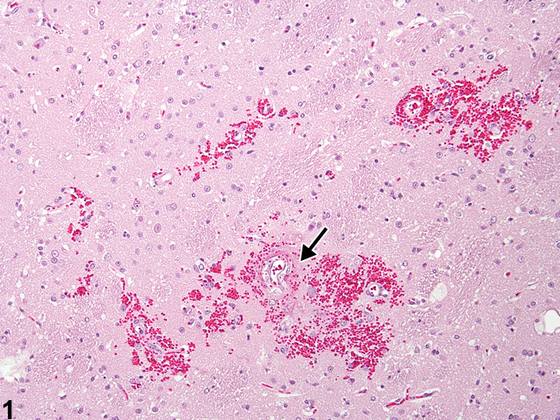
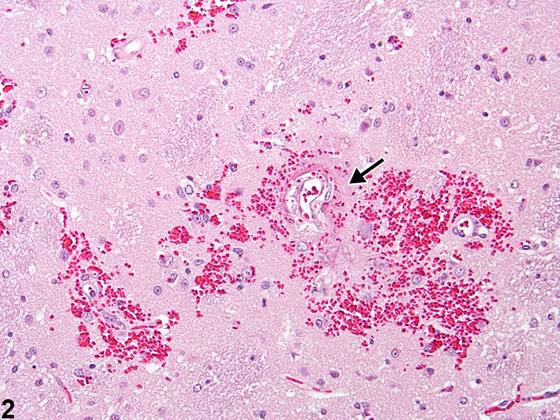
在图1和图2中,毛细血管损伤表现为局灶性(focal)出血,更重要的是,毛细血管周围出现富含蛋白质的液体渗出(箭头)。该病变容易被遗漏,因为出血可能看起来类似于处理新鲜脑组织及小血管破裂所致的死后伪影。通常,生前脑出血还伴有少量血管周围多形核白细胞,其存在可能仅持续数小时。应仔细检查血管区域是否存在提示坏死的纤维素样改变,或如图1所示,是否存在由血管周围毛细血管富含蛋白质的渗出物和出血所表示的更细微的损伤证据。在后续评估中,可通过免疫组织化学检测血管外血清白蛋白或辣根过氧化物酶的穿透来发现毛细血管的早期损伤。
诊断与分级建议(NTP 共识)
在NTP研究中出现时,应诊断出血并确定其位置和严重程度。存在并发病变时,通常诊断严重程度最高的病变。其他并发病变,若严重程度允许,可单独诊断。
图谱
英文原文
展开 NTP 官方英文描述与建议
Comment:
In Figure 1 and Figure 2 , capillary injury is present as evidenced by the criteria of focal hemorrhage and, importantly, the transudation of protein-rich fluid around the capillary (arrow). This lesion can easily be missed since the hemorrhage may appear similar to postmortem artifact induced by handling of fresh brain and rupture of small vessels. Commonly, antemortem brain hemorrhage is also accompanied by a few perivascular polymorphonuclear leukocytes whose presence may persist for only several hours. The vascular compartment should be closely examined for the presence of fibrinoid changes indicative of necrosis or, as shown in Figure 1 , for more subtle evidence of injury signified by perivascular capillary protein-rich transudate and hemorrhage. Early damage to capillaries may be detected in subsequent evaluations by using immunohistochemistry for extravascular serum albumin or penetration of horseradish peroxidase.
Recommendation:
When present in NTP studies, hemorrhage should be diagnosed and the location and severity identified. In the presence of concurrent lesions, lesions with the most severity are typically diagnosed. Other concurrent lesions may be diagnosed separately, if warranted by the severity.
来源与引用
原始条目:https://ntp.niehs.nih.gov/atlas/nnl/nervous-system/brain/Hemorrhage
图谱总目录:NTP Nonneoplastic Lesion Atlas。 内容属美国联邦政府作品(公有领域),可引用;引用时请标注来源。
建议引用格式:NTP Nonneoplastic Lesion Atlas. Hemorrhage (brain). LabSmart 中文版:
https://www.labsmart.cn/ntp/brain-hemorrhage.html
中文图谱总页(可展开对照全部 595 条):https://www.labsmart.cn/ntp-atlas.html#brain-hemorrhage