上皮增生Epithelium Hyperplasia · 鼻 · 呼吸系统 · NTP ntp-0124
诊断要点:移行上皮或呼吸道上皮增生一经出现即应诊断,并赋予严重程度分级。诊断中所列部位应反映受累的上皮细胞类型。
病变描述
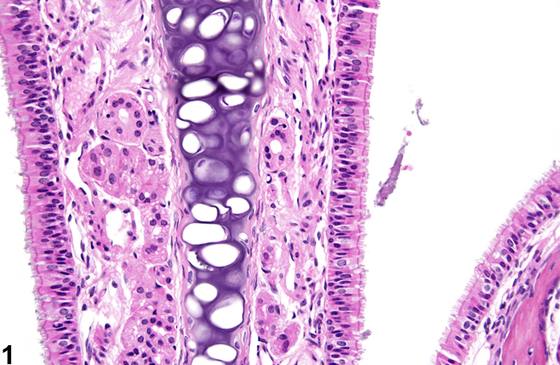
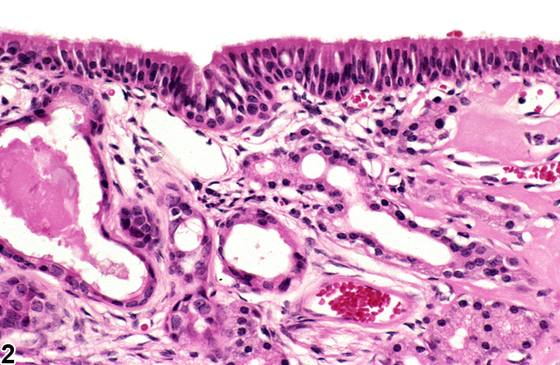
移行上皮或呼吸道上皮增生是一种相对常见的与处理相关的变化,也可见于异物和感染性病原体引起的炎性病变中。增生是细胞数量的增加,不应与再生相混淆,再生是丢失或受损细胞的替代。增生导致上皮增厚(Figure 2、Figure 3、Figure 6),并可能因细胞拥挤而使上皮形成皱褶(Figure 2、Figure 3)。然而,鼻甲尾腹侧的黏膜表面正常情况下即呈皱褶状;这不应被解释为呼吸道上皮增生。增生上皮的黏膜内陷(Figure 4、Figure 5)可延伸至固有层,并可能含有一些炎性细胞或凝结物。增生上皮的内陷被认为随增生时间延长而发生。杯状细胞增殖(Figure 6)是上皮的常见反应,常与增生同时出现。嗅上皮增生通常导致上皮层增厚(Figure 7)。
诊断与分级建议(NTP 共识)
移行上皮或呼吸道上皮增生一经出现即应诊断,并赋予严重程度分级。诊断中所列部位应反映受累的上皮细胞类型。如果能够确定增殖细胞为某一特定细胞类型(例如基底细胞或杯状细胞),则该细胞类型应作为修饰词纳入。由于这些细胞正在增殖,它们通常比非增殖的呼吸道上皮细胞略大(肥大)。只有当病理学家确信其增大程度超出增殖细胞的预期时,才应单独诊断肥大。如果上皮细胞看起来异常(例如细胞或核多形性、间变或增大)或存在异常或畸变的生长模式(例如细胞排列紊乱、角化不良或核分裂象增多或异常),则应添加“非典型(非典型性(atypical))”作为诊断修饰词(见Nose - Epithelium - Hyperplasia, 非典型性)。再生上皮细胞的细胞学特征和排列可能有一些不规则;必须注意不要将其误认为非典型增生。相关链接:Nose - Epithelium - Hyperplasia, 非典型性
图谱
英文原文
展开 NTP 官方英文描述与建议
Comment:
Transitional or respiratory epithelial hyperplasia is a relatively common treatment-related change and can also be seen in inflammatory lesions caused by foreign bodies and infectious agents. Hyperplasia is an increase in the number of cells and should not be confused with regeneration, which is replacement of lost or damaged cells. Hyperplasia results in thickening of the epithelium ( Figure 2 , Figure 3 , and Figure 6 ) and may result in cellular crowding that forces the epithelium into folds ( Figure 2 and Figure 3 ). However, the mucosal surface of the caudoventral nasoturbinate is normally folded; this should not be interpreted as respiratory epithelial hyperplasia. Mucosal invaginations of hyperplastic epithelium ( Figure 4 and Figure 5 ) may extend into the lamina propria and may contain some inflammatory cells or concretions. Invagination of hyperplastic epithelium is thought to occur with prolonged hyperplasia. Goblet cell proliferation ( Figure 6 ) is a common response of the epithelium and is often seen concurrently with hyperplasia. Hyperplasia of the olfactory epithelium typically results in thickening of the epithelial layer ( Figure 7 ).
Recommendation:
Hyperplasia of the transitional or respiratory epithelium should be diagnosed whenever present and assigned a severity grade. The site listed in the diagnosis should reflect the epithelial cell type affected. If a particular cell type can be identified as the proliferating cell (e.g., basal cell or goblet cell), that cell type should be included as a modifier. Since these cells are proliferating, they are often slightly larger (hypertrophy) than nonproliferating respiratory epithelial cells. Hypertrophy should be diagnosed separately only if the pathologist is confident that the enlargement is beyond that expected for proliferating cells. If the epithelial cells appear to be abnormal (e.g., cellular or nuclear pleomorphism, anaplasia, or enlargement) or there is an abnormal or aberrant growth pattern (e.g., disorganization of the cells, dyskeratosis, or increased or abnormal mitotic figures), the term “atypical” should be added as a diagnostic modifier (see Nose - Epithelium - Hyperplasia, Atypical ). Regenerating epithelial cells may have some irregularity in their cytologic features and arrangement; care must be taken not to mistake this for atypical hyperplasia. Related Links: Nose - Epithelium - Hyperplasia, Atypical
来源与引用
原始条目:https://ntp.niehs.nih.gov/atlas/nnl/respiratory-system/nose/Epithelium-Hyperplasia
图谱总目录:NTP Nonneoplastic Lesion Atlas。 内容属美国联邦政府作品(公有领域),可引用;引用时请标注来源。
建议引用格式:NTP Nonneoplastic Lesion Atlas. Epithelium Hyperplasia (nose). LabSmart 中文版:
https://www.labsmart.cn/ntp/nose-epithelium-hyperplasia.html
中文图谱总页(可展开对照全部 595 条):https://www.labsmart.cn/ntp-atlas.html#nose-epithelium-hyperplasia