上皮再生Epithelium Regeneration · 鼻 · 呼吸系统 · NTP ntp-0121
诊断要点:只要存在再生,且同时有坏死或变性的证据,就应诊断再生。再生不应进行分级。为传达病变的严重程度,必须同时诊断坏死或变性并对其进行分级(见 Nose - Epithelium - Degeneration 和 Nose - Epithelium - Necrosis)。
病变描述
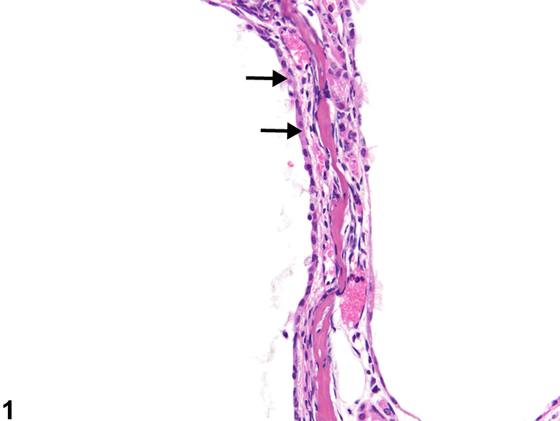
再生(Regeneration,Figure 1)是鼻结构上皮缺失后的再上皮化。新生的上皮层通常是一层扁平的、细长的细胞,取代缺失的上皮。这些细胞的细胞核常大小不一(anisokaryotic),且相对于缺损长度而言,细胞数量可能显得偏少。细胞大小不一(anisocytotic)并缺乏正常极性。受累细胞的细胞质一般呈嗜碱性。由于再生是对细胞缺失的一种反应,故通常见于变性和/或坏死区域,并可能与增生和化生同时存在。
诊断与分级建议(NTP 共识)
只要存在再生,且同时有坏死或变性的证据,就应诊断再生。再生不应进行分级。为传达病变的严重程度,必须同时诊断坏死或变性并对其进行分级(见 Nose - Epithelium - Degeneration 和 Nose - Epithelium - Necrosis)。诊断中应通过将本应存在的上皮类型(如呼吸上皮、嗅上皮)作为部位修饰词纳入,以指明病变在鼻腔内的位置。如果上皮细胞数量超出正常范围,则应诊断增生,无论其是受试物暴露的直接效应还是过度再生所致,但增生的发病机制应在病理学叙述中讨论。其他相关病变,如炎症、萎缩或化生,应单独诊断。如果再生上皮表现出显著的异型性特征,根据病理学家的判断,则应诊断“细胞异型性(atypia, cellular)”并进行分级。相关链接:Nose - Epithelium - Degeneration Nose - Epithelium - Necrosis
图谱
英文原文
展开 NTP 官方英文描述与建议
Comment:
Regeneration ( Figure 1 ) is the re-epithelialization of nasal structures following loss of the epithelium. The new epithelial layer is usually a thin layer of flattened, elongated cells that replaces the lost epithelium. The nuclei of these cells are often anisokaryotic, and there may seem to be fewer cells than there should be for the length of the defect. The cells are anisocytotic and lack normal polarity. The cytoplasm of involved cells is generally basophilic. Because it is a response to the loss of cells, regeneration is typically seen in areas of degeneration and/or necrosis, and it may coincide with hyperplasia and metaplasia.
Recommendation:
Regeneration should be diagnosed whenever present and evidence of necrosis or degeneration is also present. Regeneration should not be graded. To convey the severity of the lesion, either necrosis or degeneration must be diagnosed concurrently and graded (see Nose - Epithelium - Degeneration and Nose - Epithelium - Necrosis ). The location of the lesion in the nasal cavity should be indicated in the diagnosis by including as a site modifier the type of epithelium that should be present (e.g., respiratory, olfactory). If the number of epithelial cells exceeds that which would be considered within normal limits, hyperplasia should be diagnosed, regardless of whether it is a direct effect of test article exposure or excessive regeneration, but the pathogenesis of the hyperplasia should be discussed in the pathology narrative. Other associated lesions, such as inflammation, atrophy, or metaplasia, should be diagnosed separately. If the regenerating epithelium exhibits significant features of atypia, based on the pathologist’s judgment, then "atypia, cellular" should be diagnosed and graded. Related Links: Nose - Epithelium - Degeneration Nose - Epithelium - Necrosis
来源与引用
原始条目:https://ntp.niehs.nih.gov/atlas/nnl/respiratory-system/nose/Epithelium-Regeneration
图谱总目录:NTP Nonneoplastic Lesion Atlas。 内容属美国联邦政府作品(公有领域),可引用;引用时请标注来源。
建议引用格式:NTP Nonneoplastic Lesion Atlas. Epithelium Regeneration (nose). LabSmart 中文版:
https://www.labsmart.cn/ntp/nose-epithelium-regeneration.html
中文图谱总页(可展开对照全部 595 条):https://www.labsmart.cn/ntp-atlas.html#nose-epithelium-regeneration