异物Foreign Body · 鼻 · 呼吸系统 · NTP ntp-0137
诊断要点:异物存在时应作出诊断,但不应进行分级。如果异物位于鼻腔腔道以外的部位(例如泪管或鼻咽管),应在诊断中以部位修饰词标明该部位。
病变描述
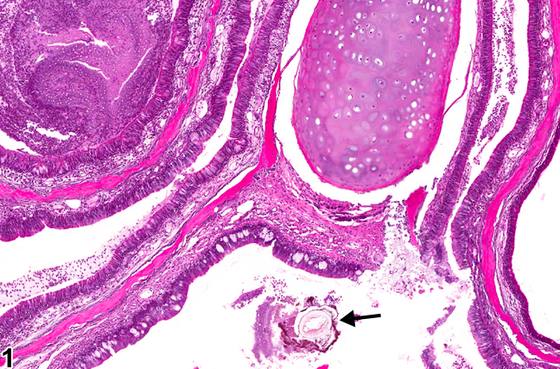
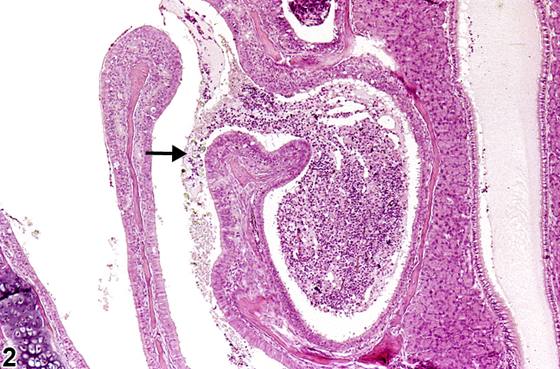
异物(foreign body)是大鼠和小鼠常见的背景性病变,通常不与暴露浓度相关。“异物”一词指鼻腔内任何异常物质。如果异物形态与受试物一致、仅见于暴露动物,且其数量与暴露浓度相关,则应使用“外来物质(foreign material)”一词而非异物(见 Nose - Foreign Material)。最常见的异物为毛干(Figure 1)和植物性物质(饲料或垫料)。毛干呈半透明、多层结构,饲料或植物性垫料可通过植物细胞壁的存在加以识别。通常该物质无法被识别(Figure 2、Figure 3,箭头)。异物可见于鼻腔任何部位、泪管、切牙管或嵌埋于组织中。吸入的物质通常引起局灶性(focal)化脓性、化脓性肉芽肿性或肉芽肿性反应,且通常被聚集的巨噬细胞和/或中性粒细胞所包围。异物邻近的上皮也可能出现改变(例如坏死或变性、鳞状化生或增生)。
诊断与分级建议(NTP 共识)
异物存在时应作出诊断,但不应进行分级。如果异物位于鼻腔腔道以外的部位(例如泪管或鼻咽管),应在诊断中以部位修饰词标明该部位。异物可能伴随的炎症及任何上皮改变不应单独诊断,除非其严重程度足以支持单独诊断。当根据形态、与暴露浓度的相关性以及仅见于暴露动物而认为该物质为受试物时,应使用“外来物质”一词。相关链接:Nose - Foreign Material
图谱
英文原文
展开 NTP 官方英文描述与建议
Comment:
Foreign bodies are a common background finding in rats and mice and are not typically correlated with exposure concentration. The term "foreign body" refers to any aberrant material in the nasal cavity. If the morphology of the foreign material is consistent with the test agent, if the material is seen only in exposed animals, and if the amount of material correlates with the exposure concentration, the term “foreign material” should be used rather than foreign body (see Nose - Foreign Material ). The most common foreign bodies are hair shafts ( Figure 1 ) and plant material (feed or bedding). Hair shafts are translucent and multilayered, and feed or plant-based bedding can be identified by the presence of plant cell walls. Often the material cannot be identified ( Figure 2 and Figure 3 , arrows). Foreign bodies can be found anywhere in the nasal cavity, in the lacrimal ducts, in the incisive ducts, or embedded in the tissues. The inhaled material typically incites a focal suppurative, pyogranulomatous, or granulomatous reaction and is usually surrounded by accumulations of macrophages and/or neutrophils. The epithelium adjacent to the foreign body may also show changes (e.g., necrosis or degeneration, squamous metaplasia, or hyperplasia).
Recommendation:
Foreign bodies should be diagnosed when present but should not be graded. If the foreign body is in a location other than the nasal lumen (e.g., lacrimal duct or nasopharyngeal duct), the location should be identified in the diagnosis with a site modifier. The inflammation and any epithelial changes that may accompany a foreign body should not be diagnosed separately unless warranted by severity. The term "foreign material" should be used when the material is thought to be the test agent based on morphology, correlation with exposure concentration, and presence only in exposed animals. Related Links: Nose - Foreign Material
来源与引用
原始条目:https://ntp.niehs.nih.gov/atlas/nnl/respiratory-system/nose/ForeignBody
图谱总目录:NTP Nonneoplastic Lesion Atlas。 内容属美国联邦政府作品(公有领域),可引用;引用时请标注来源。
建议引用格式:NTP Nonneoplastic Lesion Atlas. Foreign Body (nose). LabSmart 中文版:
https://www.labsmart.cn/ntp/nose-foreign-body.html
中文图谱总页(可展开对照全部 595 条):https://www.labsmart.cn/ntp-atlas.html#nose-foreign-body