异物Foreign Material · 鼻 · 呼吸系统 · NTP ntp-0138
诊断要点:异物(受试物或推定的受试物)只要存在即应作出诊断并分级。具体部位(例如呼吸上皮或嗅上皮、鼻咽管)应作为部位修饰词在诊断中标明。
病变描述
异物(foreign material)(Figure 1、Figure 2、Figure 3、Figure 4、Figure 5)是指吸入的颗粒状受试物或推定的受试物。因此,该术语仅适用于吸入研究或受试物被吸入或呼出至鼻腔的灌胃研究。“色素沉着(pigmentation)”一词专用于鼻腔内发现的内源性色素(含铁血黄素、脂褐素),不应用于外源性物质(见 Nose - Pigment)。如果该物质具有预期的形态学外观、仅在染毒动物中发现、且数量随暴露水平升高而增加,则可假定其为受试物。可将异物的形态学外观与肺内发现的物质进行比较(Figure 5),在吸入研究中,肺内的该物质通常更为丰富。“异物(foreign body)”一词专用于在对照动物和染毒动物中均发现的、或严重程度不随暴露水平升高而增加的吸入性植物碎片(饲料或垫料)、毛发碎片或其他物质(见 Nose - Foreign Body)。在鼻腔中见到受试物并不常见。少量惰性颗粒可能仅引起轻微反应,但反应性较强的物质可能引起炎症反应和鼻上皮的改变(例如变性或坏死、化生、萎缩)。
诊断与分级建议(NTP 共识)
异物(受试物或推定的受试物)只要存在即应作出诊断并分级。具体部位(例如呼吸上皮或嗅上皮、鼻咽管)应作为部位修饰词在诊断中标明。如果异物存在于鼻腔腔内或存在于一个以上部位,则可省略部位修饰词,并在病理学描述中描述这些部位。相关病变(例如炎症、坏死、纤维化、上皮增生)应单独诊断并分级。相关链接:Nose - Foreign Body Nose - Pigment
图谱
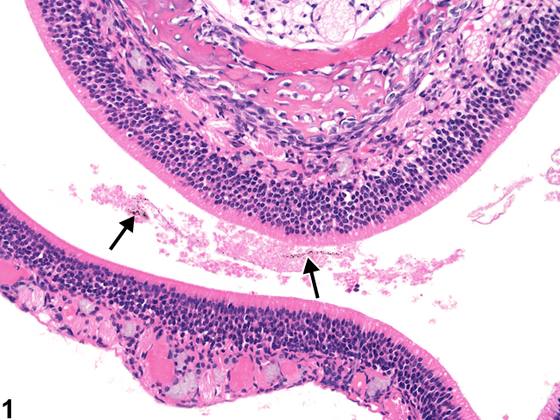
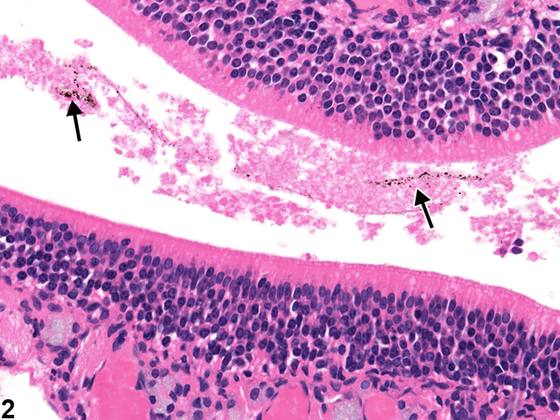
英文原文
展开 NTP 官方英文描述与建议
Comment:
Foreign material ( Figure 1 , Figure 2 , Figure 3 , Figure 4 , and Figure 5 ) refers to inhaled particulate test material or presumed test material. Therefore, this term applies only to inhalation studies or gavage studies in which the test material has been inhaled or exhaled into the nasal cavity. The term "pigmentation" is reserved for endogenous pigments (hemosiderin, lipofuscin) found in the nose and should not be used for exogenous material (see Nose - Pigment ). If the material has the expected morphologic appearance, is found only in treated animals, and increases in amount with increasing exposure level, it may be assumed to be the test agent. The morphologic appearance of the foreign material can be compared to the material found in the lung ( Figure 5 ), where, in inhalation studies, it will usually be more abundant. The term “foreign body” is reserved for inhaled bits of plant material (feed or bedding), hair fragments, or other substances that are found in control and treated animals or do not increase in severity with increasing exposure level (see Nose - Foreign Body ). It is uncommon to see the test agent in the nose. There may be little response to small amounts of inert particles, but more reactive materials may elicit an inflammatory response and changes in the nasal epithelium (e.g., degeneration or necrosis, metaplasia, atrophy).
Recommendation:
Foreign material (test material or presumed test material) should be diagnosed and graded whenever present. The specific location (e.g., respiratory or olfactory epithelium, nasopharyngeal duct) should be indicated in the diagnosis as a site modifier. If the foreign material is present in the nasal lumen or in more than one location, the site modifier may be omitted and the locations described in the pathology narrative. Associated lesions (e.g., inflammation, necrosis, fibrosis, epithelial hyperplasia) should be diagnosed and graded separately. Related Links: Nose - Foreign Body Nose - Pigment
来源与引用
原始条目:https://ntp.niehs.nih.gov/atlas/nnl/respiratory-system/nose/ForeignMaterial
图谱总目录:NTP Nonneoplastic Lesion Atlas。 内容属美国联邦政府作品(公有领域),可引用;引用时请标注来源。
建议引用格式:NTP Nonneoplastic Lesion Atlas. Foreign Material (nose). LabSmart 中文版:
https://www.labsmart.cn/ntp/nose-foreign-material.html
中文图谱总页(可展开对照全部 595 条):https://www.labsmart.cn/ntp-atlas.html#nose-foreign-material