炎症Inflammation · 前胃 · 消化系统 · NTP ntp-0214
诊断要点:炎症应予以诊断,并给出严重程度分级以及指示炎症持续时间或类型的修饰词(即 急性(acute)、化脓性(suppurative)、慢性(chronic)、慢性 active 或 肉芽肿性(granulomatous))。
病变描述
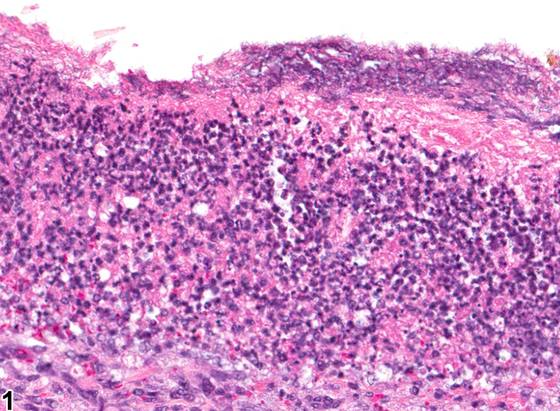
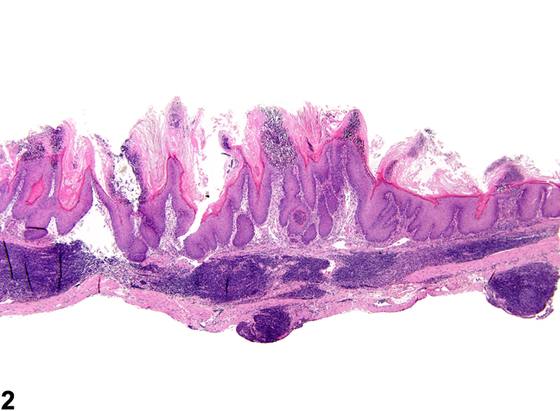
炎症可发生于前胃,如同在胃肠道其他部位一样。病变可为自发性(特发性)、与灌胃操作相关,或由直接/间接化学毒性所致。前胃炎症最常伴随上皮增生、溃疡或糜烂发生。炎症可诊断为急性、化脓性、慢性、慢性活动性或肉芽肿性。在急性炎症中,主要浸润细胞为中性粒细胞,尽管也可能存在较少的巨噬细胞和淋巴细胞。还可能有水肿或充血的表现。中性粒细胞也是化脓性炎症中的主要浸润细胞类型(Figure 1),但中性粒细胞聚集,且其中许多发生退变(化脓性渗出物)。渗出物还可能含有细胞碎片,既来自 resident 细胞群体,也来自浸润的白细胞;含纤维蛋白的蛋白性液体;较少的巨噬细胞;偶见的淋巴细胞或浆细胞;以及可能的感染因子。肉眼观察,这些病变将以脓液存在为特征。在渗出物周围组织中,可能存在成纤维细胞、纤维结缔组织和混合性炎症细胞,取决于病变的慢性程度。淋巴细胞在慢性炎症中占主导(Figure 2)。淋巴细胞在慢性活动性炎症中也占主导(Figure 3、Figure 4),但也存在显著数量的中性粒细胞。两种病变均可能含有巨噬细胞。肉芽肿性炎症是慢性炎症的另一种形式,但该诊断要求存在显著数量的聚集性、大的、活化的巨噬细胞、上皮样巨噬细胞或多核巨细胞。
诊断与分级建议(NTP 共识)
炎症应予以诊断,并给出严重程度分级以及指示炎症持续时间或类型的修饰词(即 急性(acute)、化脓性(suppurative)、慢性(chronic)、慢性 active 或 肉芽肿性(granulomatous))。严重程度分级取决于前胃受累面积的范围和细胞浸润的密度。符合脓肿的病变诊断为化脓性炎症。增生、糜烂或溃疡区域内的炎症一般不记录,除非炎症的严重程度需要单独诊断。
图谱
英文原文
展开 NTP 官方英文描述与建议
Comment:
Inflammation can occur in the forestomach as elsewhere in the gastrointestinal tract. Lesions can be spontaneous (idiopathic), related to gavage procedure, or due to direct/indirect chemical toxicity. Inflammation in the forestomach most often occurs in association with epithelial hyperplasia, ulcer, or erosion. Inflammation can be diagnosed as acute, suppurative, chronic, chronic active, or granulomatous. In acute inflammation , the predominant infiltrating cell is the neutrophil, though fewer macrophages and lymphocytes may also be present. There may also be evidence of edema or hyperemia. The neutrophil is also the predominant infiltrating cell type in suppurative inflammation ( Figure 1 ), but the neutrophils are aggregated, and many of them are degenerate (suppurative exudate). The exudate may also contain cell debris, both from the resident cell populations and from infiltrating leukocytes; proteinaceous fluid containing fibrin; fewer macrophages; occasional lymphocytes or plasma cells; and, possibly, an infectious agent. Grossly, these lesions would be characterized by the presence of pus. In the tissue surrounding the exudate, there may be fibroblasts, fibrous connective tissue, and mixed inflammatory cells, depending on the chronicity of the lesion. Lymphocytes predominate in chronic inflammation ( Figure 2 ). Lymphocytes also predominate in chronic active inflammation ( Figure 3 and Figure 4 ), but there are also a significant number of neutrophils. Both lesions may contain macrophages. Granulomatous inflammation is another form of chronic inflammation, but this diagnosis requires the presence of a significant number of aggregated, large, activated macrophages, epithelioid macrophages, or multinucleated giant cells.
Recommendation:
Inflammation should be diagnosed and given a severity grade and a modifier that indicates the duration or type of inflammation (i.e., acute, suppurative, chronic, chronic active, or granulomatous). The severity grade depends on the extent of area of forestomach affected and the density of the cellular infiltrate. Lesions consistent with an abscess are diagnosed as suppurative inflammation. Inflammation in areas of hyperplasia, erosion, or ulcer is not generally recorded unless the severity of the inflammation warrants a separate diagnosis.
来源与引用
原始条目:https://ntp.niehs.nih.gov/atlas/nnl/alimentary-system/stomach-forestomach/Inflammation
图谱总目录:NTP Nonneoplastic Lesion Atlas。 内容属美国联邦政府作品(公有领域),可引用;引用时请标注来源。
建议引用格式:NTP Nonneoplastic Lesion Atlas. Inflammation (stomach-forestomach). LabSmart 中文版:
https://www.labsmart.cn/ntp/stomach-forestomach-inflammation.html
中文图谱总页(可展开对照全部 595 条):https://www.labsmart.cn/ntp-atlas.html#stomach-forestomach-inflammation